
A QPPV Appointment Demonstrates Responsibility, Not Oversight
A QPPV appointment demonstrates responsibility.
It does not automatically demonstrate oversight.
That distinction becomes important during pharmacovigilance inspections.
Most organizations can identify who their QPPV is. The more difficult task is demonstrating how the QPPV maintains visibility over the pharmacovigilance system, remains aware of significant changes, and exercises oversight across affiliates, vendors, outsourced activities, and the PSMF itself.
The PSMF should do more than record the name of the QPPV. It should help demonstrate how oversight is maintained in practice.
Key Takeaway: Inspectors do not assess QPPV oversight based on job titles or organizational charts alone. They assess whether the organization can demonstrate that the QPPV had access to current information, visibility into significant changes, oversight of delegated activities, and involvement in relevant governance decisions. The strongest evidence often comes from controlled governance records maintained through the PSMF, including approval workflows, Annex I records, and audit trails.
Why QPPV Oversight Is Not Proven by Appointment
EMA GVP expectations place significant responsibilities on the QPPV, including oversight of the pharmacovigilance system and access to relevant information needed to perform those responsibilities effectively.
Because of this, inspectors rarely stop at confirming that a QPPV has been appointed.
Instead, they often explore whether the individual could realistically exercise oversight.
For example, was the QPPV informed of significant system changes? Did the QPPV have visibility into outsourced activities? Could the QPPV access current information about the pharmacovigilance system? Were governance decisions visible to the QPPV when required?
The presence of a named QPPV answers one question.
The ability to demonstrate oversight answers another.
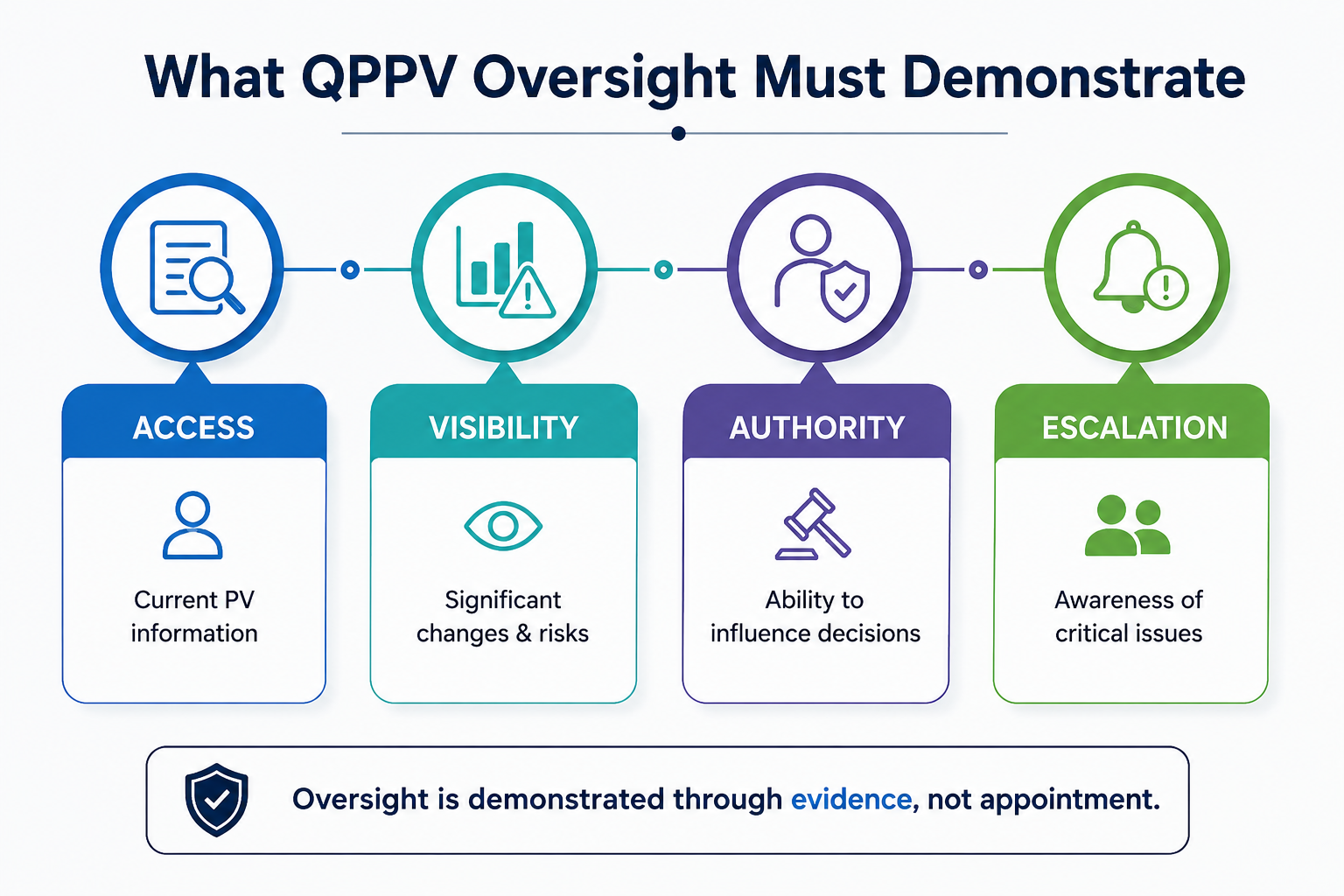
What the PSMF Should Prove About QPPV Oversight
QPPV oversight is not demonstrated by one section of the PSMF.
It is demonstrated through several connected forms of evidence: access, authority, and delegated activity control.
Together, these show whether the QPPV can realistically maintain oversight of the pharmacovigilance system.
1. Access to Current Pharmacovigilance Information
Effective oversight depends on access to accurate and current information.
If critical information is spread across spreadsheets, email chains, affiliate repositories, and disconnected systems, QPPV visibility becomes difficult to demonstrate.
The PSMF should help show that relevant information can be accessed when needed and that significant updates affecting the pharmacovigilance system are reflected appropriately. PSMF Manager's External Data Sources integration helps connect source information with controlled PSMF workflows, supporting better visibility and traceability when updates occur.
This includes information related to organizational structures, pharmacovigilance responsibilities, affiliate arrangements, governance changes, delegated activities, and medical support arrangements where applicable.
Where access to appropriate medical expertise is required, the arrangement should be documented clearly and supported by governance records where relevant.
2. Authority to Influence PV System Decisions
Oversight requires more than awareness.
The QPPV should have a clear route to influence decisions that affect the pharmacovigilance system.
This becomes important when there are vendor transitions, safety database changes, organizational restructuring, affiliate changes, or outsourced pharmacovigilance activities.
The PSMF should help demonstrate how responsibilities, reporting structures, and governance processes support QPPV involvement where appropriate.
An organizational chart may show reporting lines.
It does not always prove that the QPPV had meaningful involvement in decisions affecting the system.
3. Control Over Delegated Activities
Delegation is often necessary in large pharmacovigilance systems.
But outsourcing does not remove responsibility from the marketing authorization holder.
Inspectors may examine how oversight is maintained across third-party providers, affiliates, local teams, and contracted pharmacovigilance activities.
The PSMF should help demonstrate who performs delegated activities, how responsibilities are assigned, how oversight is maintained, and how significant changes are escalated or governed. This is especially important when multiple vendors, affiliates, local providers, or subcontracted activities are involved.
Oversight should remain visible even when activities are delegated.
Why Global and Local PSMFs Create Additional Oversight Challenges
Oversight becomes more complex when organizations operate across multiple countries and maintain both global and local PSMFs.
Local teams may manage affiliate information, local contacts, local procedures, local vendors, and country-specific activities.
Without consistent governance, updates may become fragmented across different records.
This can make it harder to demonstrate that significant information remained visible beyond the local level.
Country-specific pharmacovigilance arrangements may create additional local documentation and access expectations. This makes controlled governance across global and local records even more important.
For multinational organizations, effective oversight depends on maintaining clear visibility across both global and local PSMFs.
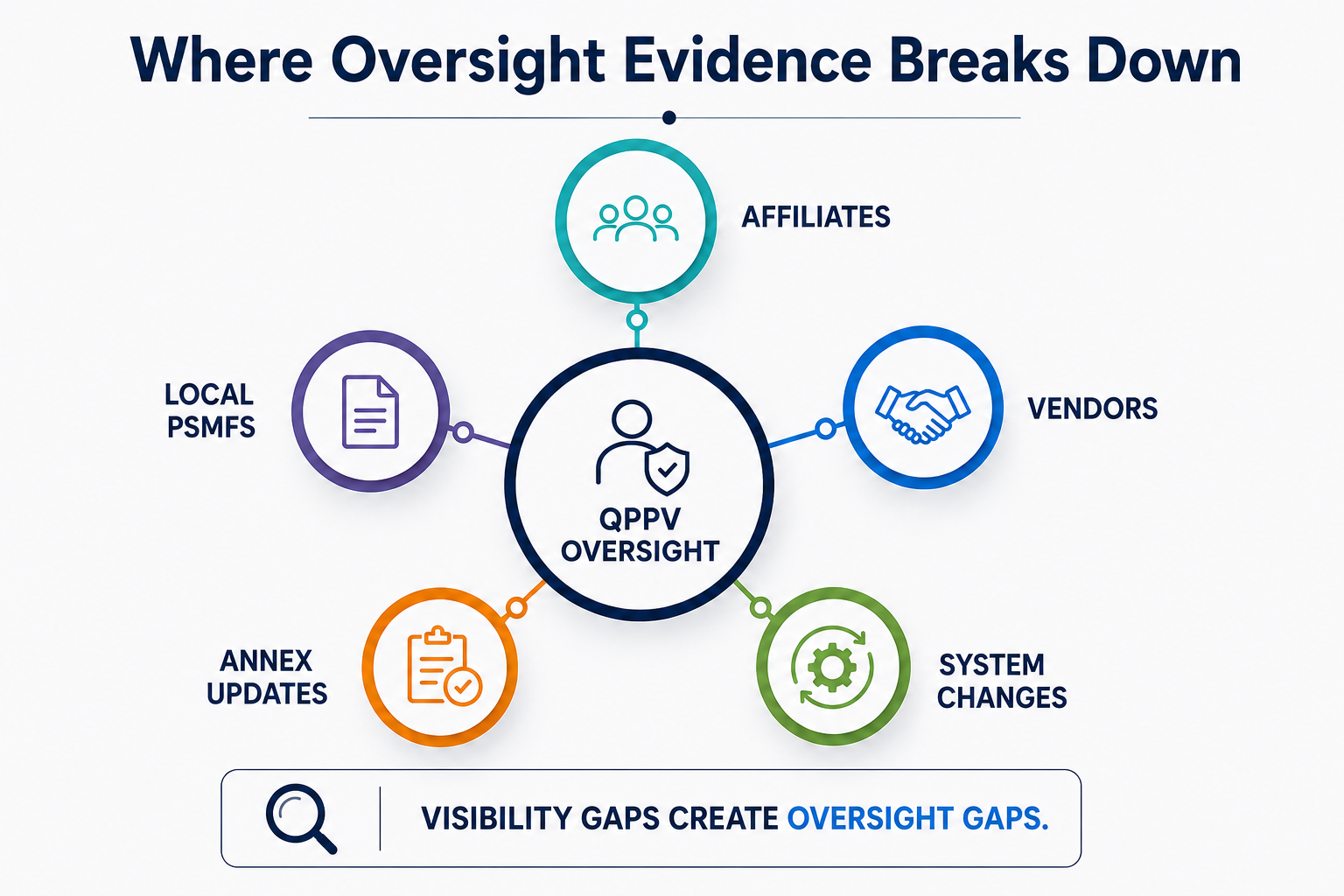
Where Oversight Evidence Commonly Breaks Down
In many organizations, oversight failures do not occur because the QPPV is uninvolved.
They occur because evidence is difficult to demonstrate.
Affiliate updates may be managed outside controlled workflows. Vendor changes may be communicated informally. Annex updates may happen after the actual change. Approvals may sit separately from the underlying PSMF record.
When inspection teams request evidence, organizations may find themselves reconstructing oversight activities after the fact.
This is often far more difficult than demonstrating contemporaneous governance.
Why Annex I Often Becomes Critical Evidence
Annex I provides a record of relevant changes affecting the PSMF and the pharmacovigilance system.
When maintained contemporaneously, it can help demonstrate that significant changes were identified, documented, and governed appropriately.
This is particularly important when inspectors examine the timing of updates, change visibility, governance activities, and oversight evidence.
Commission Implementing Regulation (EU) 2025/1466 reinforces the need to document major or critical deviations from pharmacovigilance procedures, including their impact and management, in the PSMF until they are resolved. This makes accurate, traceable change records even more important.
The value of Annex I is not simply recording that a change occurred.
Its value is helping demonstrate how that change was governed.
How Controlled PSMF Governance Supports Oversight
Strong oversight is rarely demonstrated through a single document.
It is demonstrated through connected governance evidence.
This may include Annex I records, reviewer workflows, approval workflows, audit trails, version history, delegated activity records, and governance decisions.
Together, these records help demonstrate that significant changes were visible, reviewed, and appropriately managed.
The stronger the governance framework, the easier it becomes to demonstrate oversight.
How PSMF Manager Supports QPPV Oversight
PSMF Manager helps organizations maintain controlled governance around the PSMF and related pharmacovigilance documentation.
Changes can originate through controlled workflows or External Data Sources. Reviewers remain responsible for evaluating updates before approval. Audit trails preserve historical records and governance activity. Approved content becomes part of the controlled PSMF record. A PDF version is generated, QPPV approval is completed, and version lock is applied.
Features such as Version History, Tracked Changes, Global and Local PSMFs, External Data Sources, and Ask AI help support visibility and traceability while maintaining human review and QPPV oversight throughout the process.
AI may assist by identifying differences between versions or suggesting Annex I Change Log content, but final decisions remain with Reviewers, Approvers, Coordinators, and Admins.
Building a More Defensible Oversight Record
The strongest PSMFs do more than identify the QPPV.
They help demonstrate how oversight is exercised across the pharmacovigilance system.
When governance structures, Annex I records, delegated activity oversight, reviewer workflows, approval records, and visibility mechanisms remain connected, organizations are in a stronger position to demonstrate oversight during inspection.
Because ultimately, inspectors are not looking for evidence that a QPPV exists.
They are looking for evidence that oversight exists.
Request a demo of PSMF Manager today to see how controlled workflows, traceability, and governance controls can help maintain an inspection-ready PSMF.