Many MAHs Run One Pharmacovigilance System Across Two Regulatory Frameworks
Many Marketing Authorisation Holders operate a single pharmacovigilance system across both the United Kingdom and the European Union.
The challenge is not maintaining two separate pharmacovigilance systems.
The challenge is maintaining alignment between two PSMFs that must satisfy different regulatory requirements while continuing to describe the same underlying pharmacovigilance system.
This is where governance becomes critical.
A global pharmacovigilance system may support both UK and EU products. However, differences in QPPV arrangements, National Contact Person requirements, UK PSMF registration, regional annex content, and notification processes create additional governance complexity.
For inspectors, the question is rarely whether both PSMFs exist.
The question is whether the organization can demonstrate that both remain current, traceable, and aligned with the live pharmacovigilance system.
Key Takeaway: UK and EU PSMFs may describe the same pharmacovigilance system, but they are governed through different regulatory control points. Differences in QPPV oversight, National Contact Person requirements, PSMF registration, regional annex content, and notification processes create alignment challenges for MAHs. Inspection readiness depends on demonstrating that regional differences remain controlled, traceable, and consistently maintained.
Why UK and EU PSMFs Should Not Be Treated as Duplicates
At first glance, UK and EU PSMFs may appear similar.
Both may describe the same pharmacovigilance system, including its governance structures, responsibilities, procedures, and oversight arrangements. Where these elements are identical, the relevant core sections can be mirrored across both PSMFs.
The main differences generally arise within the regional annexes and UK-specific regulatory information. Governance risk occurs when these regional differences are not updated, reviewed, and maintained consistently.
Regional requirements may evolve separately. Contact points may change. Product classifications may be updated. Vendor arrangements may shift. Local processes may be revised.
If these updates are reflected in one PSMF but not the other, alignment begins to weaken. Over time, the issue is no longer whether both documents exist. The issue is whether the MAH can demonstrate that both records remain current, controlled, and traceable.
The challenge is not document duplication.
The challenge is maintaining controlled traceability across both PSMFs.
Where UK and EU PSMF Oversight Structures Begin to Differ
One of the most visible differences between the two systems involves pharmacovigilance oversight.
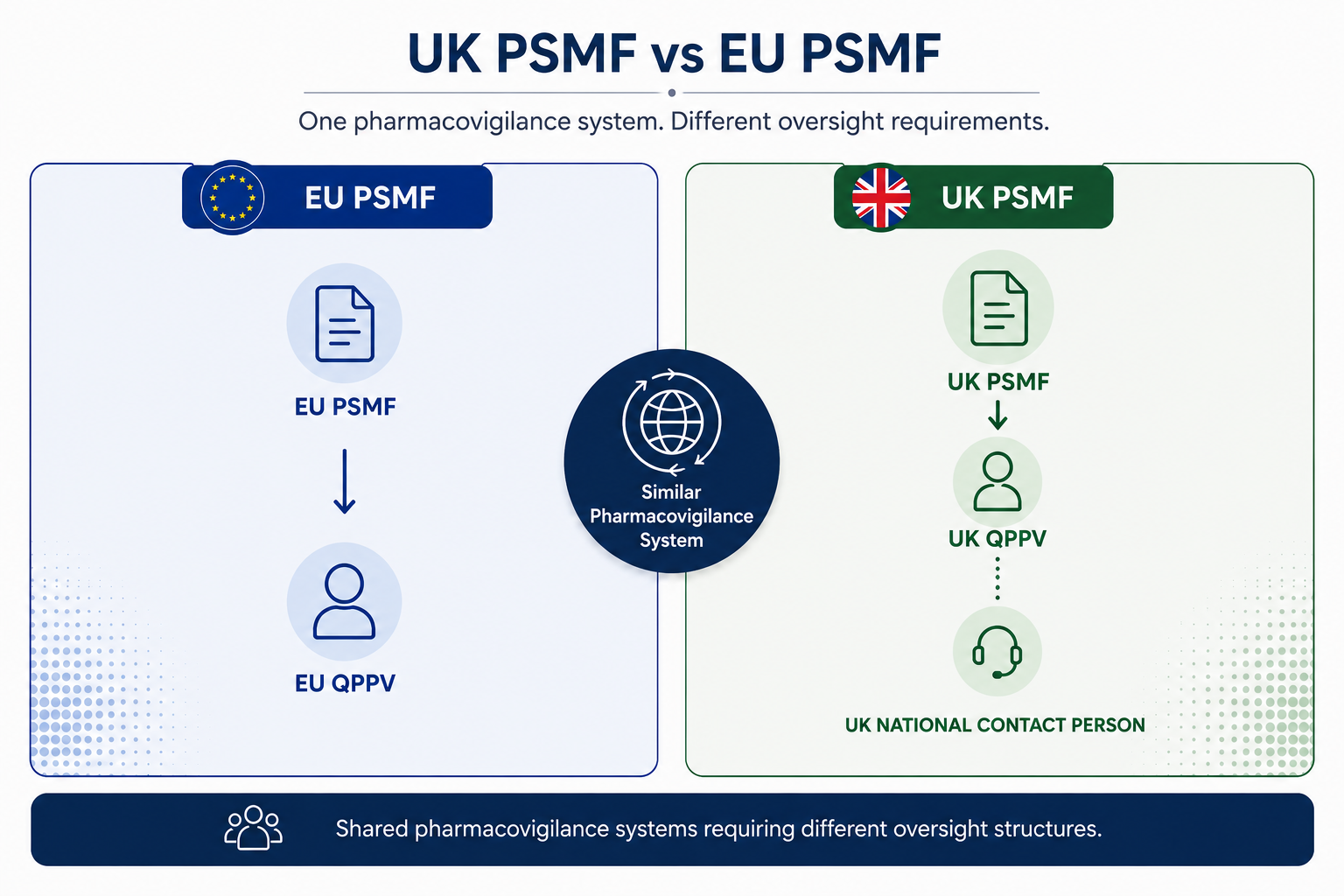
For EU-authorised products, the QPPV must reside and operate in the Union.
For UK-authorised products, the UK QPPV may reside and operate in the UK, EU, or EEA. Where the UK QPPV does not reside and operate in the UK, a UK National Contact Person for Pharmacovigilance should be in place.
This creates an additional oversight layer that does not exist within the EU framework. Organizations must maintain clear documentation of responsibilities, escalation pathways, communication structures, and oversight arrangements.
For inspectors, these records help demonstrate that regional pharmacovigilance responsibilities remain appropriately governed.
Administrative Control Points for UK and EU PSMF Governance
Governance differences extend beyond personnel.
The UK and EU maintain separate approaches to PSMF registration and administrative maintenance.
Within the EU, QPPV details and PSMF location information are maintained in the EMA's Article 57 database.
Within the UK, each pharmacovigilance system covering UK-authorised products should have a unique UK PSMF number assigned by the MHRA.
The UK also operates a distinct notification framework for pharmacovigilance system updates. Changes involving the UK QPPV, National Contact Person, or the UK PSMF access location may require submission through the MHRA Submissions Portal as an SPS update notification rather than through the previous Type IA(IN) variation route.
An additional consideration is the location in the UK where the UK PSMF can be electronically accessed. Incorrect notification or registration of this access location can create regulatory complications and affect future submissions.
These requirements may appear administrative. However, they often become important inspection evidence because they demonstrate how the pharmacovigilance system remains controlled over time.
Where Regional Annexes Begin to Diverge
The greatest differences emerge in the annexes, as the main body of the PSMF remains the same with identical information in the Sections of both EU PSMF and UK PSMF.
This is particularly important because annexes are the most dynamic part of the pharmacovigilance system.
Following the implementation of the Windsor Framework from 1 January 2025, organizations may need to manage Category 1 and Category 2 products within UK portfolios. This can affect how regional information is maintained within supporting annexes.
Examples may include:
- Legal references maintained within Annex A
- Regional performance metrics maintained within Annex F
- Product portfolio information maintained within Annex H
- Regional contact information
- Vendor oversight records
- Affiliate responsibilities
- UK QPPV and National Contact Person details, where applicable
These differences do not require separate pharmacovigilance systems.
They do require controlled regional governance.
As annexes become more dynamic, maintaining alignment between UK and EU records becomes increasingly important.
Why Annex Governance Becomes an Inspection Readiness Issue
Most governance failures do not originate in the core narrative of the PSMF.
They originate in the annexes, where regional information changes more frequently.
A vendor agreement may change. A UK QPPV or National Contact Person arrangement may be updated. A PSMF access location may change. A regional responsibility may shift.
If these updates are captured in the UK PSMF but not the EU PSMF, or the other way around, discrepancies begin to emerge. Over time, traceability becomes harder to demonstrate.
This is why Version History, Tracked Changes, audit trails, and reviewer oversight become essential when maintaining both UK and EU PSMFs.
Inspectors are not only reviewing the content itself. They are evaluating whether the organization can demonstrate how that content remained current.
Change Log entries should be recorded contemporaneously during the workflow. This helps create a clear and defensible history of governance decisions.
Similar challenges often appear when organizations struggle to maintain traceable change records across multiple PSMFs. Our article on PSMF Change Tracking explores how Annex I, version governance, and audit trails support inspection readiness.
How Controlled Governance Helps Maintain Alignment
The objective is not maintaining multiple disconnected PSMFs.
The objective is maintaining one pharmacovigilance system while preserving regional differences where required.
Many organizations achieve this through a Global and Local PSMFs approach, where a global core structure is supported by regional annexes.
The challenge then becomes demonstrating:
- Which information is shared globally
- Which information is region-specific
- When updates occurred
- Who reviewed them
- Which versions were approved
- How regional differences were maintained
Without this visibility, alignment becomes increasingly difficult to defend during inspections.
How PSMF Manager Supports UK and EU PSMF Governance
Managing UK and EU PSMFs requires more than document updates.
It requires controlled governance over regional differences.
PSMF Manager supports this through Global and Local PSMFs, Tracked Changes, Version History, External Data Sources, controlled PSMF Generation, and AI-assisted review support.
Global and Local PSMFs help organizations maintain shared content while preserving regional requirements.
Tracked Changes and Version History help maintain visibility over how records evolve over time.
External Data Sources support controlled synchronization of source information while preserving reviewer oversight, archived records, and audit trails before updates become part of controlled PSMF records.
Ask AI can assist reviewers by providing review comments for the updates per relevant regulatory expectations and suggesting Annex I Change Log content where applicable.
However, AI does not approve updates, replace reviewers, replace QPPV oversight, or generate final PSMFs independently.
Human review remains central throughout the governance process.
Maintaining Alignment Without Losing Control
The UK PSMF should not be treated as an EU PSMF with a different label.
Both documents may describe the same pharmacovigilance system, but they operate under different regulatory control points.
QPPV arrangements, National Contact Person requirements, UK PSMF numbers, regional annex content, and notification processes all require dedicated attention.
Organizations that manage these differences successfully are not necessarily maintaining more documents.
They are maintaining stronger governance.
Request a demo of PSMF Manager to see how controlled workflows, audit trails, version governance, and Global and Local PSMFs can help maintain inspection-ready pharmacovigilance documentation across both UK and EU requirements.