A PSMF Can Look Complete and Still Fail to Prove Control
A PSMF can look complete and still fail to prove control.
The issue is usually not the final document. It is the change history behind it.
If updates are added late, approvals sit in emails, annex changes are tracked separately, or old versions cannot be retrieved, the PSMF may not show how the pharmacovigilance system actually changed over time.
Under EMA GVP Module II, marketing authorization holders need change control systems and robust processes to stay informed of relevant changes so the PSMF can be maintained accordingly. Documented changes should include at least the date, person responsible, and nature of the change.(ema.europa.eu)
That is why PSMF change tracking matters. It is not just a record of edits. It is evidence that changes were captured, reviewed, approved, and remain traceable.
What PSMF Change Tracking Really Means
PSMF change tracking goes beyond redlines in a document.
It should cover:
- Changes to the PSMF narrative
- Annex updates
- Source data changes
- Vendor or affiliate updates
- SOP and process changes
- Reviewer comments
- Approvals
- Version history
- Audit trail records
EMA GVP Module II also includes a dedicated section on change control, logbook, versions, and archiving. This means change tracking is part of PSMF governance, not only a formatting step.
Why Manual Logs Break Down
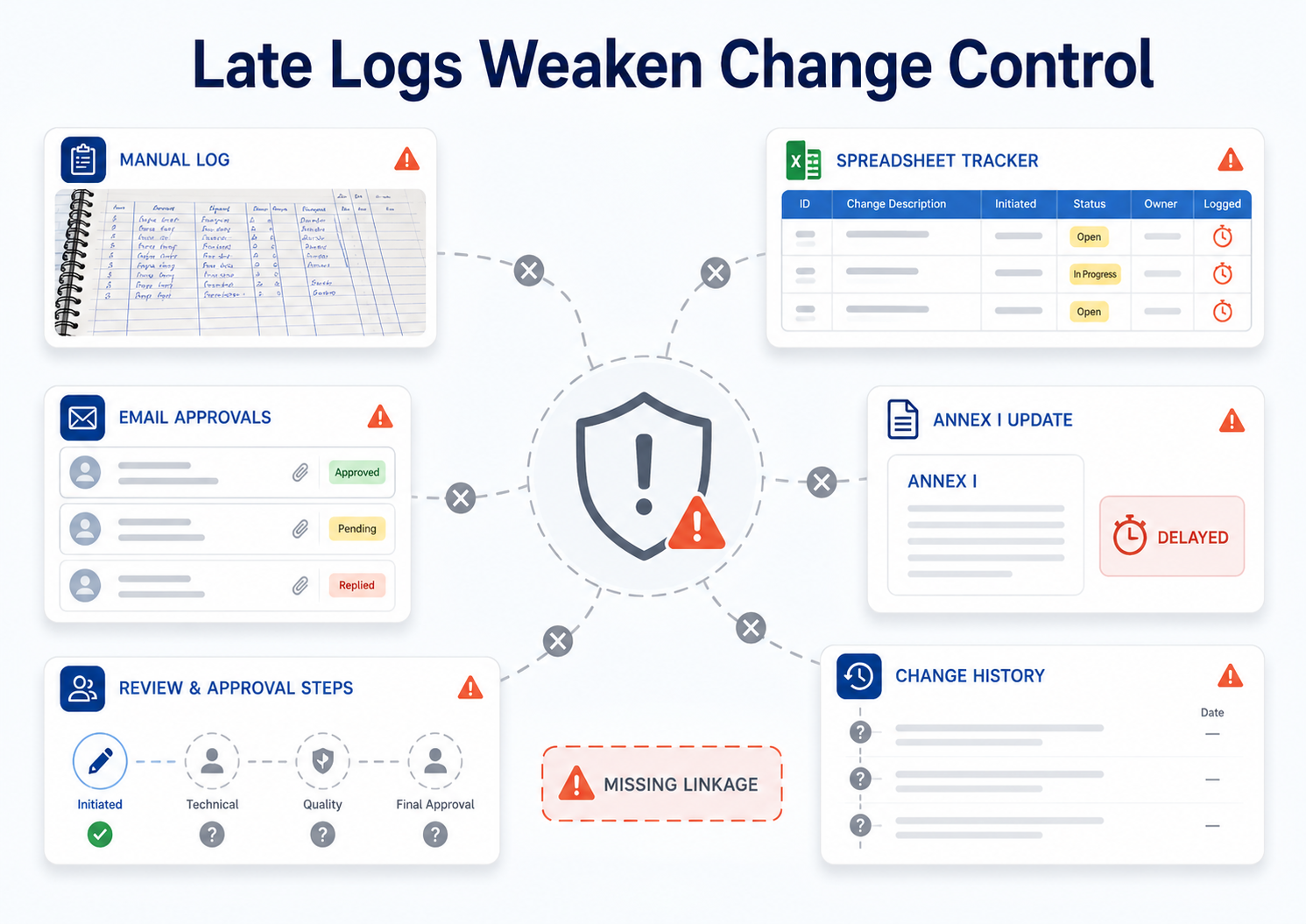
Manual logs often record that a change happened. They do not always prove how the change moved through control.
Common problems include:
- Change Log entries added after the update
- Unclear change owners
- Missing reviewer comments
- Approvals stored in emails
- Annex updates tracked in separate files
- Old versions saved in shared folders
- QPPV visibility depending on follow-ups
The biggest risk is retrospective reconstruction. When teams update the logbook later, instead of with the change, they lose the recollection ability of all events that have occurred and actual edits, while trying to reconstruct data from earlier.
A manual log may answer:
"What changed?"
Automated tracking should answer:
"What changed, who reviewed it, when was it approved, who approved it, and which version became active?"
Annex I: The Center of PSMF Change Control
Annex I is where change tracking becomes inspection-relevant.
It acts as the logbook for important changes to the PSMF and the pharmacovigilance system. EMA GVP Module II states that changes to the PSMF must be recorded in the logbook and that descriptive changes to the content of the master file must be recorded. Change history for annex information needs to be available on demand, with the logbook indicating the date of PSMF content revisions or annex updates.
This is why Annex I should be consistently updated with every change made.
If a vendor arrangement changes, a safety database is updated, an SOP is revised, or an affiliate responsibility changes, the related PSMF impact should be reviewed as part of the same workflow.
If Annex I is updated late after the change occurred in the past, it becomes a reconstruction exercise. If it is updated with the change, it becomes evidence of control.
What Automated Change Tracking Adds
Automated change tracking helps teams move from manual recordkeeping to controlled evidence.
| Manual Log | Automated Tracking |
|---|---|
| Updated after the fact | Captures change during the workflow |
| Owner may be unclear | User attribution is visible |
| Review stored in email | Review status is linked |
| Annex changes may be missed | Annex impact is traceable |
| Version history is separate | Historical versions are preserved |
| QPPV visibility depends on follow-up | Pending and approved changes are visible |
This does not remove human review. It makes the review trail easier to prove.
How Change Tracking Supports QPPV Oversight
The QPPV needs visibility into whether the PSMF reflects the current pharmacovigilance system.
Weak change tracking makes that harder. If pending changes, affiliate inputs, source updates, and approvals are scattered, oversight depends on manual follow-up.
Automated change tracking gives the QPPV a clearer view of:
- Changes awaiting review
- Approved updates
- Rejected or revised edits
- Active PSMF overview
- Annex I entries
- Audit trail history
This matters during inspections because the question is not only whether the final PSMF exists. The question is whether the organization can prove how it remained current.
EMA also states that the PSMF should be permanently available for inspection and provided within 7 days if requested by competent authorities. Weak change tracking makes that 7-day window more stressful.
Where AI Can Help Without Taking Control Away
AI can support PSMF change tracking when it is used carefully.
It can help reviewers:
- Compare changes with source content
- Flag inconsistencies
- Suggest Annex I Change Log entries
- Check whether changes stay aligned with EMA GVP Module II expectations
- Summarize review points
PSMF Manager's Ask AI supports AI-assisted change reviews and Annex I Change Log suggestions. It can help critique edits, check accuracy, confirm coherence of files and data, and propose Change Log entries at the time of change request creation.
But AI should not approve changes, replace QPPV judgment, or overwrite controlled content. It should support review, not take control away.
How PSMF Manager Supports Change Tracking
PSMF Manager helps PV teams move from disconnected manual logs to controlled change tracking.
- Tracked Changes helps teams track PSMF changes, manage review workflows, and maintain audit-ready records.
- Version History preserves time-stamped records, historical versions, user actions, and accountability.
- External Data Sources help source updates move into controlled review instead of staying in disconnected systems.
- PSMF Generation helps generate structured PSMF documents from approved content and Annex I Change Log information.
Together, these features help teams show what changed, who reviewed it, when it was approved, and how it became part of the active PSMF.
From Manual Records to Continuous Control
Manual change logs can support basic documentation, but they often create risk when the PSMF becomes complex, global, or inspection-sensitive.
Automated systems give PV teams a better way to keep change control visible.
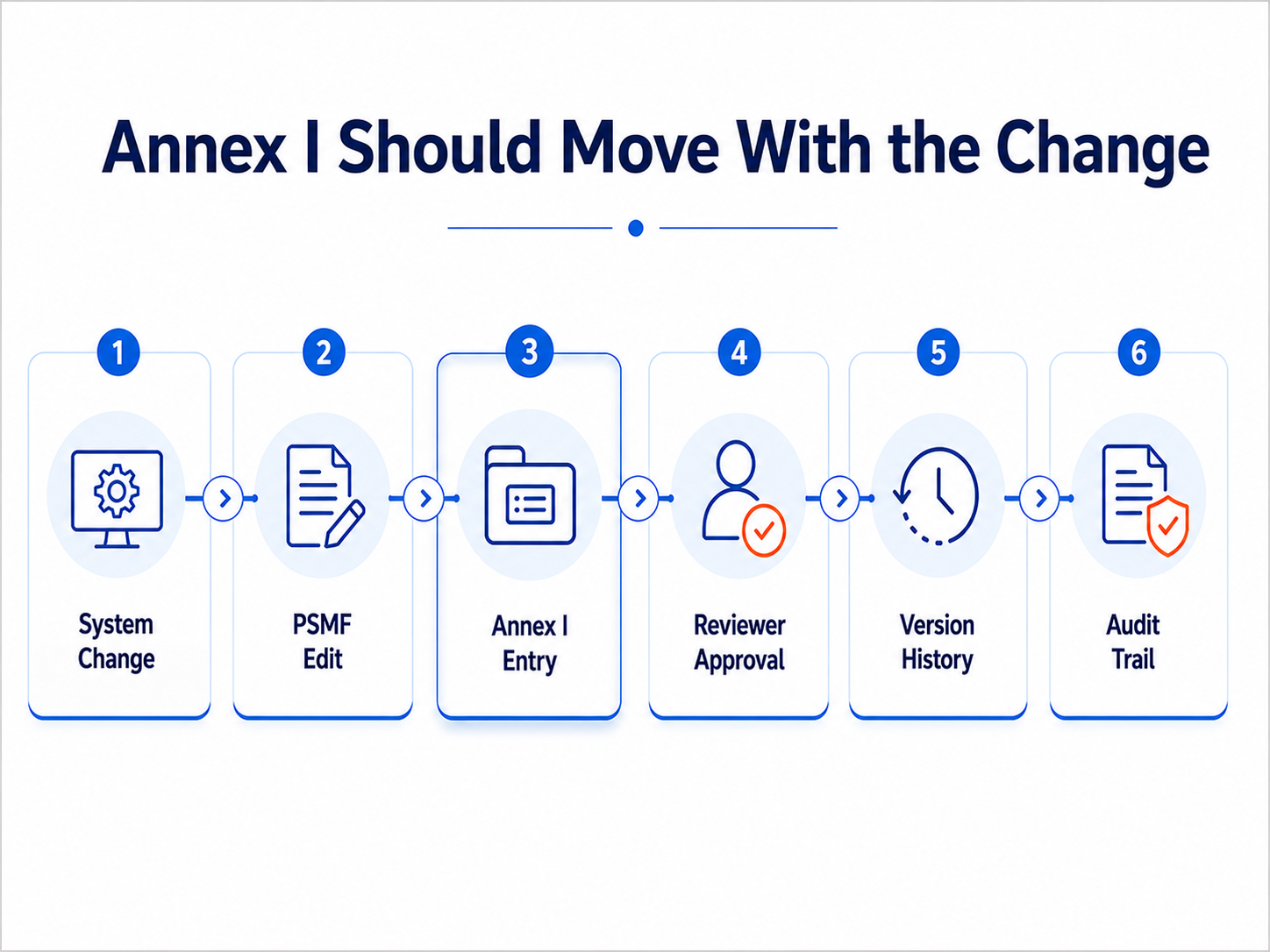
They help connect source updates, PSMF edits, Annex I entries, reviewer decisions, version history, and audit trails into one controlled workflow.
That is the real value of automated change tracking. It helps the PSMF remain a current, traceable reflection of the live pharmacovigilance system.
See how PSMF Manager helps PV teams manage tracked changes, Annex I updates, version history, and inspection-ready records. Request a demo