A mid-sized pharmaceutical company outsources literature screening to a pharmacovigilance service provider.
The PSMF lists the vendor. The agreement defines responsibilities. Everything looks complete.
Then the inspector asks:
"Your vendor uses another provider for literature screening. Where is your written consent for this subcontracting, and when did you last audit them?"
The second provider exists. The work is being done. But it appears nowhere in the vendor map, the agreements or the audit plan.
The regulation did not add a vendor to their system.
It made them accountable for the one already there.
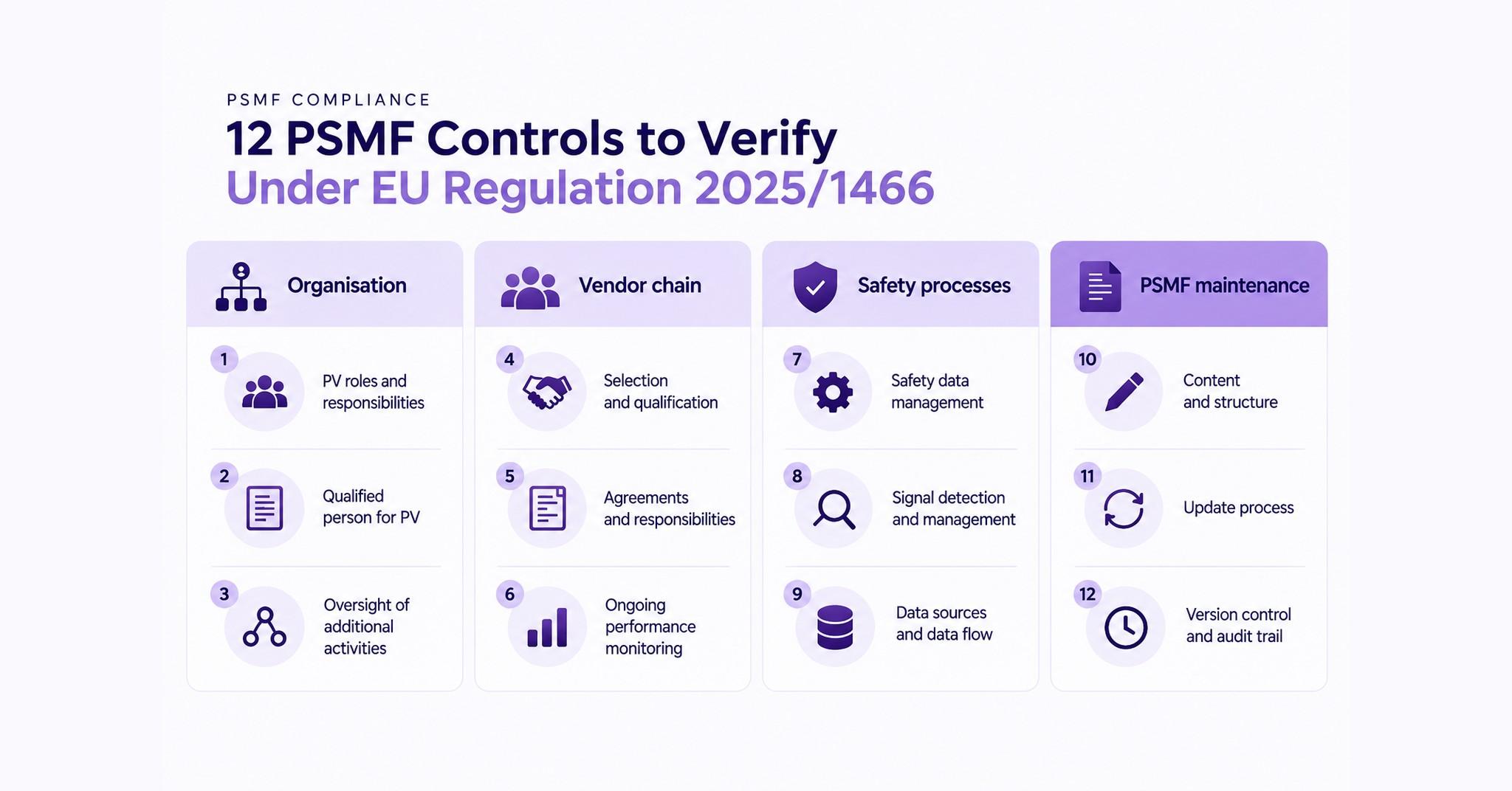
Quick note: Implementing Regulation (EU) 2025/1466 amended Implementing Regulation (EU) No 520/2012 and applies from 12 February 2026. MAHs should verify PSMF controls covering organisational mapping, deviations, subcontracting, audits, signals, ICSRs and safety reporting processes.
What Does EU Regulation 2025/1466 Change for the PSMF?
Implementing Regulation (EU) 2025/1466 was adopted on 22 July 2025 and published in the Official Journal on 23 July 2025.
It has applied since 12 February 2026, with certain provisions related to EudraVigilance monitoring and deletion of Article 21(2) applying earlier from the date of entry into force.
It is the first substantive amendment to Implementing Regulation (EU) No 520/2012, which defined requirements for pharmacovigilance systems, quality systems and PSMF content, since 2012.
The amendment reduces some administrative burden. Deviations are the clearest example: only significant deviations now need to stay in the PSMF (see Control 2).
But it raises expectations in three important areas:
- Accountability across the organisation
- Oversight of vendors and subcontractors
- Evidence that controls actually work
The focus has shifted from how much is documented to how well the pharmacovigilance system is controlled.
How to Use This Checklist for Your PSMFs
Each control covers three things: what changed, what to verify in your PSMF and what evidence an inspector will expect to see during a PV inspection.
Part A: Organisation and Quality System
1. Site-by-Activity Mapping
What changed: The PSMF should provide clearer visibility of where pharmacovigilance activities are performed.
What to verify: Check whether the PSMF identifies the locations responsible for:
- ICSR collection and evaluation
- Safety database activities
- PSUR preparation
- Signal detection
- Risk management plan activities
- Safety variations
- Study management
Evidence for inspections: A current activity map showing actual responsibilities, including outsourced activities.
2. Deviation Classification and Management
What changed: Only significant deviations, their impact and management need to remain documented in the PSMF until resolved.
What to verify: Fewer deviations in the PSMF means the classification decision itself carries more weight. Define clear criteria, for example:
- Significant: a missed regulatory reporting timeline, or a failure affecting safety data processing
- Minor: an administrative formatting issue with no impact on PV activities
Every classification decision should have defined ownership, an impact assessment, resolution tracking and closure documentation.
Evidence for inspections: Deviation criteria, assessment records and evidence showing why an issue was included or excluded.
Part B: Vendor and Subcontractor Chain
3. Subcontractor Roles and Responsibilities
What changed: PV subcontracting now requires clearer accountability across the entire vendor chain.
What to verify: Your pharmacovigilance agreements should define:
- Assigned PV activities
- Responsibilities
- Communication routes
- Oversight expectations
Evidence for inspections: Agreements showing who performs each pharmacovigilance activity.
4. Written Consent for Further Subcontracting and Safety Data Exchange
What changed: Third parties cannot subcontract assigned PV activities without the MAH's written consent. Contract requirements must also flow down the subcontracting chain.
What to verify: Map the full chain:
- Primary vendor
- Secondary vendors
- Activities each one performs
- Approval records for each arrangement
Evidence for inspections: Written consent records, subcontractor agreements and safety data exchange provisions.
5. Risk-Based Pharmacovigilance Audits
What changed: Audit programmes must ensure pharmacovigilance activities are appropriately covered.
What to verify: Check whether the audit plan includes:
- Internal PV activities
- Critical vendors
- Literature screening providers
- Safety system suppliers
Evidence for inspections: A risk-based audit plan showing why vendors were included or excluded.
Part C: Safety Processes
6. EudraVigilance Monitoring and Signal Management
What changed: MAHs must monitor EudraVigilance data alongside other relevant sources. The regulation also introduces a 30-day timeline for confirming signals that require further analysis.
What to verify: Review signal detection procedures, EudraVigilance monitoring responsibilities and signal escalation workflows.
Evidence for inspections: Signal procedures and records demonstrating timely assessment.
7. Duplicate Submission Prevention
What changed: Quality systems must include processes to prevent duplicate submissions.
What to verify: Review case processing procedures, duplicate detection controls and quality checks.
Evidence for inspections: Duplicate management procedures and quality records.
8. ICSR Standards and Data Quality
What changed: The regulation reinforces alignment with international data standards, including MedDRA, IDMP and Standard Terms.
What to verify: Confirm that procedures and systems support required ICSR data elements, literature case handling and standardised terminology. Literature ICSRs should include date of issue information where available.
Evidence for inspections: Case processing procedures and system configuration records.
9. PSUR and PASS Responsibilities
What changed: PSURs must include implementation of risk minimisation measures and effectiveness results. PASS protocols must be submitted to the EU PAS Register before data collection begins, with final abstracts submitted within the required timeframe.
What to verify: Review PSUR procedures, PASS responsibilities and risk management processes.
Evidence for inspections: Documented procedures, ownership and regulatory submission records.
Part D: PSMF Maintenance and Traceability
10. Annex and Organisational Updates
What changed: Every control above can change who does what, where and with which system. Those changes must reach the PSMF.
What to verify: Confirm that updates to vendors, sites, responsibilities and systems are reflected in the relevant PSMF sections and annexes. Cross-check annexes against the activity map (Control 1) and vendor chain (Controls 3 and 4).
Evidence for inspections: Updated annexes that match current agreements and the activity map.
11. Version History and Change Tracking
What changed: Implementing the regulation means several PSMF updates in a short period. A regulatory update is only useful if you can show when each change happened.
What to verify: Each PSMF version should carry its change history, review records and approval evidence.
Evidence for inspections: A version history showing the PSMF before and after the February 2026 updates.
12. PSMF Logbook Traceability
What changed: The logbook connects every update to a timeline. A PSMF updated after February 2026 without a matching logbook entry may raise questions about whether changes were managed proactively.
What to verify: Every significant update should show:
- What changed
- Why it changed
- Who reviewed it
- When it was approved
Evidence for inspections: Logbook entries traceable to each significant change.
PSMF Compliance Checklist: 12 Controls at a Glance
| Control | PSMF Area | Evidence to Prepare |
|---|---|---|
| Site mapping | Organisation structure | Activity ownership map |
| Deviation criteria | Quality system | Classification records |
| Vendor responsibilities | Agreements | Contracts |
| Subcontracting approval | Vendor oversight | Written consent |
| Audit coverage | Quality system | Audit plan |
| Signal monitoring | Safety surveillance | Signal procedures |
| Duplicate prevention | Case processing | Quality controls |
| Data standards | Systems and procedures | System documentation |
| PSUR/PASS oversight | Regulatory processes | Submission records |
| Annex updates | PSMF maintenance | Updated annexes |
| Version history | Change control | Review records |
| Logbook entries | Lifecycle management | Traceable changes |
Where Do MAHs Most Often Fall Short?
"Can you show every company performing pharmacovigilance activities?"
- The gap: a vendor list copied from an old organisation chart misses subcontractors.
- The fix: rebuild the vendor map from agreements and activities, not from memory.
"Why was this deviation excluded from the PSMF?"
- The gap: no written classification criteria, so the decision is hard to defend.
- The fix: document criteria and record every inclusion or exclusion decision.
"Does your audit plan cover outsourced activities?"
- The gap: the audit plan covers primary vendors only.
- The fix: extend risk-based coverage to secondary vendors and critical suppliers.
"When was this PSMF change implemented?"
- The gap: no logbook entry, so the timeline is unclear.
- The fix: link every significant update to a dated, approved logbook entry.
Where Should MAHs Start?
If the checklist feels large, start with the vendor chain. Subcontracting consent is the most visible new requirement and the easiest gap for an inspector to find.
- Map the full vendor chain (Controls 1, 3 and 4)
- Write down deviation classification criteria (Control 2)
- Extend the audit plan to cover every vendor on the new map (Control 5)
- Reflect all changes in annexes, version history and the logbook (Controls 10 to 12)
How PSMF Manager Supports Regulatory Change Management
Regulatory changes rarely touch one section. A single vendor update may affect organisation information, annexes, agreements, responsibilities and logbook records.
PSMF Manager helps keep these updates connected through structured workflows, version history and traceable approvals. When a change occurs:
- The update is identified.
- Impacted PSMF areas are reviewed.
- Supporting information is updated.
- Review and approval activities are recorded.
- Version history maintains traceability.
This turns regulatory changes into managed updates across the PSMF lifecycle, rather than inspection surprises.
The Bar Did Not Move Down
The next time an inspector asks about your vendor chain, the answer should not depend on who remembers the arrangement.
The PSMF should show:
- Every provider
- Every responsibility
- Every approval
- Every significant change
The regulation trimmed the PSMF.
It did not lower the bar.
It moved the focus from how much you document to how well you control.
Request a demo of PSMF Manager