
A pharmaceutical company launches a patient support programme managed by a commercial team and an external vendor. Safety information begins flowing through the programme's digital platform.
Fourteen months later, during a pharmacovigilance inspection, an inspector asks:
"Where is this programme described in your PSMF, and how are reports from it classified?"
The PV team checks the Pharmacovigilance System Master File (PSMF). It covers spontaneous reports, literature monitoring and clinical trial sources, but the patient support programme is not clearly reflected.
The data was flowing. The PSMF did not reflect the full system.
This is the type of gap ICH E2D(R1) brings into focus.
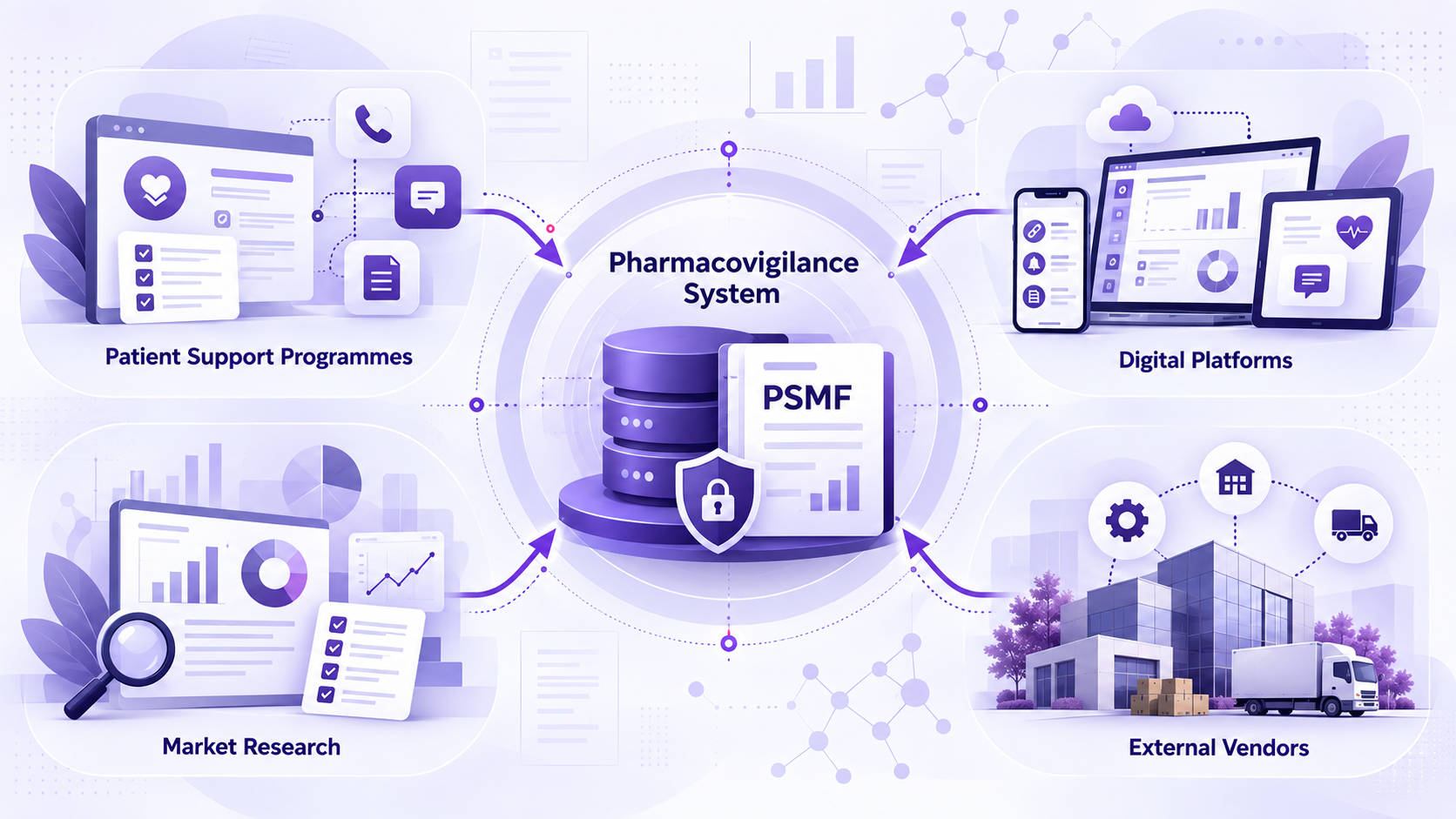
The revised guideline recognises that safety information now comes from a broader range of sources, including patient support programmes, digital platforms, market research activities, mobile health technologies and other organised data collection systems.
For MAHs, the challenge is not simply identifying these sources. It is ensuring that actual pharmacovigilance operations, procedures and the PSMF under EMA GVP Module II remain aligned.
ICH E2D(R1) effective date: EMA implemented the guideline in the EU on 18 March 2026, with the six-month MAH transition period ending on 18 September 2026.
Key Takeaway: ICH E2D(R1) requires MAHs to review how evolving post-approval safety data sources are identified, classified and managed. Any source that becomes part of the pharmacovigilance system should be reflected through appropriate PSMF updates, procedures and governance controls.
What Has ICH E2D(R1) Changed for Post-Approval Safety Data Management?
ICH E2D(R1) is the first revision of the post-approval safety data management guideline since 2003.
The revision recognises that safety information is no longer limited to traditional reporting channels. Pharmacovigilance systems now interact with a broader range of data sources, including:
- Patient support programmes
- Market research programmes
- Digital platforms and mobile applications
- Social media channels
- Non-interventional studies
- Organised data collection systems
- Literature sources
The update also provides additional guidance around safety data collected from non-interventional studies with primary data collection and those involving secondary use of data.
In the EU, ICH E2D(R1) operates alongside regional pharmacovigilance requirements. EMA GVP Module VI continues to provide regional expectations for case management, while the PSMF requirements remain governed by EMA GVP Module II.
One important question for PV teams is:
Does your PSMF reflect each safety data source that is part of your pharmacovigilance system today?
Which Safety Data Sources Should Be Reviewed Under ICH E2D(R1)?
Many new safety data sources are managed outside traditional PV teams.
A patient support programme may sit with medical affairs. A digital platform may be managed by marketing/IT teams. A market research activity may be owned by commercial teams.
However, if these activities generate safety information, they become relevant to the pharmacovigilance system.
| Safety Data Source | Data Type Consideration | Typical Business Owner | PSMF Impact |
|---|---|---|---|
| Patient support programmes (PSPs) | Often solicited | Medical affairs, commercial teams or vendors | Source listing, agreements, procedures |
| Market research programmes | Depends on programme design | Commercial teams or agencies | Classification, vendor oversight |
| MAH-owned digital platforms and apps | Depends on data collection method | Digital, medical affairs, marketing or commercial teams | Systems, workflows and responsibilities |
| Social media channels | Usually unsolicited unless actively collecting information | Communications or digital teams | Monitoring responsibilities |
| Organised data collection systems | Generally solicited | PV teams or external partners | Intake process and reporting workflow |
| Non-interventional studies | Primary or secondary data use | Clinical, epidemiology or medical teams | Data handling and oversight |
| Literature monitoring | Unsolicited | PV teams or vendors | Existing surveillance process |
The key question is not only:
"Where do safety reports come from?"
It is:
"Does the PSMF describe how these sources enter and operate within the pharmacovigilance system?"
Why Does Solicited vs Unsolicited Classification Matter?
One of the most important operational changes under ICH E2D(R1) is understanding how different safety data sources are classified.
A source that actively collects information from patients or healthcare professionals may represent a solicited reporting environment.
Examples include:
- Patient support programmes
- Market research programmes
- Organised data collection systems
Other sources, such as spontaneous reports received through standard channels or passive social media monitoring, may represent unsolicited information.
This distinction matters because classification affects how safety information is handled, including:
- Data processing workflows
- Assessment approach
- Reporting responsibilities
- System configuration
- Compliance monitoring
A source cannot be managed correctly if the organisation does not first understand what type of safety information it generates.
This is why source classification should be reflected consistently across:
- SOPs
- Safety systems
- Vendor agreements
- Training materials
- PSMF records
Why Is the PSMF Where ICH E2D(R1) Gaps Become Visible?
The PSMF is the map of the pharmacovigilance system.
Inspectors compare:
- What the PSMF states
- What procedures describe
- What teams actually do
If a patient support programme exists but is missing from the PSMF, the organisation has a gap between its documented and actual pharmacovigilance system.
Under EMA GVP Module II, the PSMF should provide an accurate description of the current pharmacovigilance system, including relevant processes, responsibilities and safety data sources.
This makes PSMF maintenance a lifecycle activity rather than a periodic document update.
Organisations managing frequent changes should ensure that updates are traceable through appropriate workflows, change records and version history.
Where Should ICH E2D(R1) Changes Appear in Your PSMF?
Sources of Safety Data
The PSMF should reflect relevant sources that contribute to the pharmacovigilance system.
This includes reviewing whether new sources such as:
- Patient support programmes
- Digital platforms
- Market research activities
- Non-interventional studies
are accurately documented.
Contracts and Agreements
External partners should have clearly defined pharmacovigilance responsibilities.
Review:
- Patient support programme vendors
- Market research agencies
- Technology providers
- Data service providers
The relevant PV obligations should align with operational practice.
Written Procedures
SOPs should explain:
- How new sources are identified
- How reports are classified
- How information enters PV workflows
- Who owns review activities
The PSMF should reflect these procedures.
Computerised Systems
ICH E2D(R1) also has implications for safety system configuration.
E2B(R3) updates include changes to C.5.4 (Drug/Device Assessed Information) and related Code List 8 values to better support classification of solicited reports from sources such as:
- Patient support programmes
- Market research programmes
- Organised data collection systems
EU implementation of updated EudraVigilance values will follow the relevant system change process.
PV teams should review whether their systems and reporting workflows can accurately represent new source classifications.
Training, Quality Systems and Audits
New safety data sources often involve teams outside PV.
A practical governance question is:
Has every team involved in collecting patient or healthcare professional information been included in the PV process?
This includes:
- Medical affairs
- Marketing teams
- Digital teams
- External vendors
Performance Indicators
Compliance monitoring should consider whether different sources create different risks.
Examples:
- Reporting timeliness from patient support programmes
- Vendor reporting compliance
- Data quality trends by source
Logbook Updates
A major change to the pharmacovigilance system should be reflected through the PSMF logbook.
A missing logbook entry after implementing new safety data sources may raise questions about when the change occurred and how the organisation maintained oversight.
How Should MAHs Update Their PSMF for ICH E2D(R1)?
1. Create a Safety Data Source Inventory
Review all sources across:
- PV
- Medical affairs
- Commercial teams
- Digital channels
- External partners
The goal is identifying sources that may not currently appear in the PSMF.
2. Classify Each Source Correctly
Determine whether each source represents:
- Solicited reporting, including organised data collection
- Unsolicited reporting
Ensure the classification matches procedures and system configuration.
3. Establish a PV Governance Gate
A preventive step is creating a mandatory PV review before launching:
- Patient support programmes
- Digital health platforms
- Market research activities
- New data collection initiatives
The question should be:
"Could this activity generate safety information?"
If yes, PV should be involved before launch, not after implementation.
4. Align Documents, Systems and Agreements
Confirm that:
- SOPs
- Vendor agreements
- Safety systems
- PSMF content
all describe the same process.
5. Record the Change
Complete:
- PSMF logbook entry
- Relevant annex updates
- Review and approval activities
- Documented training on the updates made for relevant stakeholders
The change should remain traceable.
How ePSMF Supports Changing Safety Data Sources
As pharmacovigilance systems become more connected, maintaining source visibility requires more than updating individual documents.
An ePSMF approach helps organisations manage:
- Source updates
- Change history
- Reviewer activities
- Approval records
- Version history
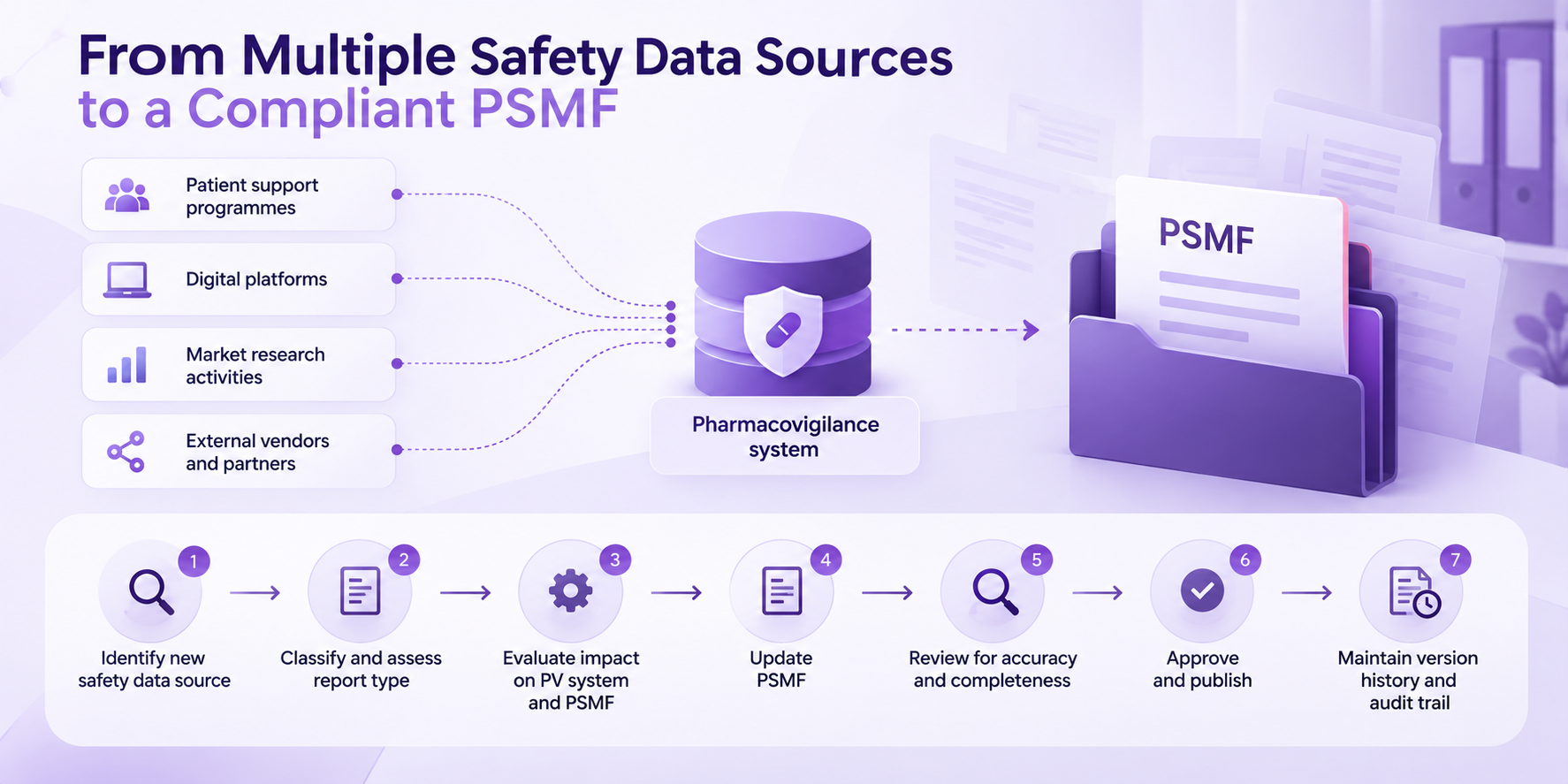
With PSMF Manager, a new safety data source can move through a structured process:
- New source identified and assessed.
- Change request initiated.
- Relevant information collected through workflows or External Data Sources.
- Reviewer validates impact on PSMF sections and annexes.
- Approved changes are recorded with traceability and version history.
External Data Sources support structured updates from integrated safety information sources while maintaining reviewer oversight.
When the inspector asks about the patient support programme, the answer should not depend on who remembers the project.
The PSMF should accurately reflect:
- What the source is
- How it is classified
- Who manages it
- How safety information enters the system
- When the change was documented
ICH E2D(R1) did not create new safety data sources.
It removed the excuse for not knowing where they come from.
PSMF Manager helps organisations keep source lists, annexes and change records aligned so a new safety data source becomes a tracked change, not a surprise.
Request a demo of PSMF Manager