
Understanding the 7-Day Rule in Pharmacovigilance
The pharmacovigilance system master file (PSMF) is the key pharmacovigilance document that reflects how your pharmacovigilance system operates. Under EMA GVP Module II, companies must submit their PSMF within 7 calendar days when requested by a National Competent Authority (NCA) or the European Medicines Agency (EMA) inspector.
This requirement, known as the 7-day rule in pharmacovigilance, is not a preparation timeline. It demonstrates the validation of whether your PSMF compliance already exists.
Regulators expect that your PSMF reflects your system as it operates in reality, not as it was last updated.
You can refer to the official guidance here: EMA GVP MODULE II guidance
The Data Lock Point in PSMF Submission
The data lock point (DLP) for PSMF preparation is one of the most critical aspects of the 7-day rule.
At the time of the regulatory request, a data lock point is defined. The submitted PSMF must reflect the system exactly as it existed on that DLP date.
This creates a potential gap between documentation and real-time operations.
Even if your PSMF was updated recently, any changes made after that update must still be included. Without structured tracking, teams rely on manual reconciliation, which often leads to inconsistencies.
This is where most failures in PSMF inspection readiness begin.
Why PSMF Inspection Readiness Must Be Continuous
The PSMF is often the first document reviewed during a PV inspection. It sets the context for how regulators understand your pharmacovigilance system.
Inspection data shows that PSMF-related gaps are frequently linked to major findings. Inconsistent or outdated information often leads to deeper scrutiny.
This makes continuous PSMF inspection readiness essential as a process, not just as a standalone case during the inspection preparation phase.
It is not about updating the PSMF document periodically. It is about maintaining accuracy at all times.
The Challenge of Global and Local PSMFs
Organizations operating across multiple regions must manage both global and local PSMFs.
These need to remain aligned while meeting local regulatory requirements. In practice, this leads to duplication, inconsistencies, and version control challenges.
Structured systems help solve this by maintaining a central source of truth while allowing controlled local adaptations. You can explore this approach here: Global and Local PSMF Management
Where the 7-Day Rule Breaks in Practice
Most breakdowns in PSMF compliance happen in areas where data changes frequently and tracking is limited.
| Annex | Common Issue | Impact |
|---|---|---|
| Annex B | Missing agreements | Weak vendor oversight |
| Annex C | Missing contacts | Incomplete safety data flow |
| Annex G | Outdated audits | Gaps in compliance |
| Annex I | Incomplete logbook | Missing audit trail |
Beyond annexes, inconsistencies between narrative sections and supporting data are also common. These gaps are quickly identified during inspections.
Why Change Tracking & Logging Is Critical for PSMF Compliance
Maintaining attributable and accurate audit trails of all changes made is essential for compliance with GxP-regulated PSMF systems.
Tracking the actual changes made,word, file for file, and maintaining a log of all changes as an audit trail (Activities log) is critical.
Every system change must be recorded, traceable, and reflected in the PSMF.
You can see how this works here: Tracked Changes in PSMF
The Role of External Data in PSMF Accuracy
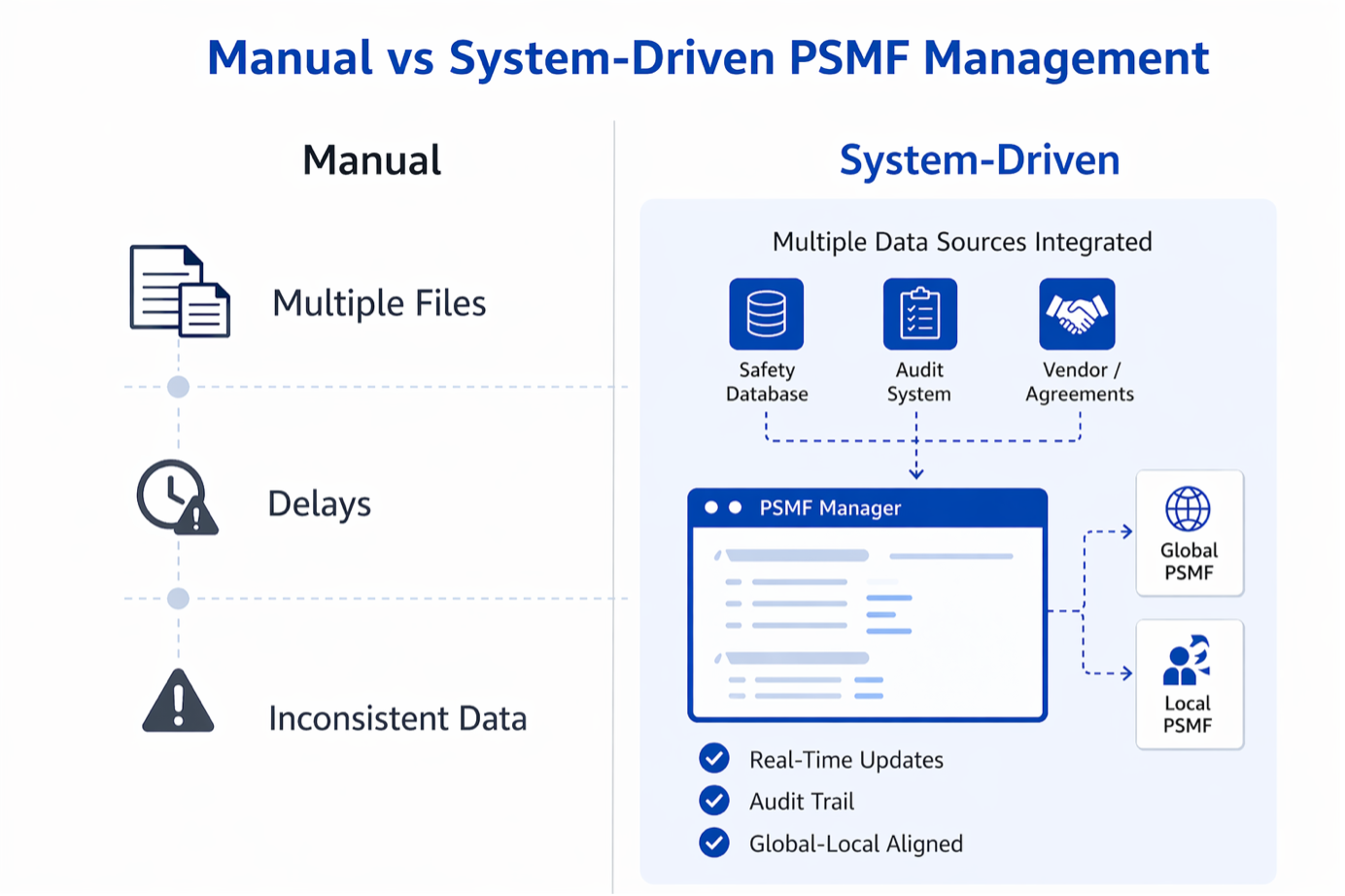
A PSMF depends on multiple external data sources such as safety databases, audit systems, and vendor records.
Keeping this data updated manually in the PSMF is time-consuming and prone to delays and inaccuracies/inconsistencies.
Integrated systems reduce this risk by connecting external data directly to the PSMF, ensuring updates are incorporated in real time.
Learn more: External Data Sources Integration
From Document to System: The Shift in PSMF Management
PSMF management is moving from a document-based approach to a system-driven approach.
Organizations now need continuous updates, centralized visibility, and structured workflows.
Modern PSMF generation platforms also enable faster and more reliable document generation, reducing preparation time during inspections.
The 7-Day Rule Reflects System Maturity
The 7-day rule in PSMF is not about speed. It reflects how well your system is maintained.
A compliant pharmacovigilance system ensures that:
- The PSMF is always updated
- Data is consistent across sections and annexures
- Changes are fully traceable
If these conditions are met, the 7-day requirement becomes routine.
If not, even small gaps can lead to inspection risks.
Ready to transform your PSMF management? Move to a structured system built for continuous PSMF compliance and inspection readiness. Request Demo of PSMF Manager today