
Global & Local PSMFs are about Governance, Not about Document Choice
Most organizations treat global and local PSMFs as a structural decision.
-
One document or multiple.
-
Centralized or distributed.
Regulators do not assess structure. They assess whether the pharmacovigilance system is controlled across all affiliates.
Under EMA GVP Module II, the PSMF must reflect the actual operating model, including affiliate execution, third-party involvement, and QPPV oversight.
A global PSMF that does not reflect local execution is incomplete.
A local PSMF that diverges from global governance creates contradictions.
This is the same root issue seen in manual PSMF management audit failures, where documentation exists but control does not.
Local PSMF Requirements Are Not Variations. They Are Legal Obligations
Global consistency does not replace local compliance.
Each region imposes specific requirements that must be reflected in the pharmacovigilance system master file structure.
In the UK, following Brexit, a UK PSMF became mandatory from January 2021. It must be maintained within the UK and linked to a UK QPPV or National Contact Person. It is not a copy of the EU PSMF. It must reflect UK-specific pharmacovigilance activities and oversight.
In Brazil, ANVISA requires a local PSMF maintained in Portuguese, with clear documentation of local safety responsibilities, reporting timelines, and integration with the global system. Structural expectations differ, particularly around local accountability and documentation format.
In GCC countries, regulators require a Pharmacovigilance Sub-System File (PSSF). This is not a standalone local document. It describes how the global pharmacovigilance system operates within that country, including local safety officer responsibilities, product scope, and reporting pathways.
Australia requires a local supplement aligned with TGA expectations. India is increasingly aligning with structured PvMF expectations, especially for MAHs operating at scale.
These are not documentation preferences.
They define how the system must be represented locally.
Where Global vs Local PSMF Compliance Breaks in Practice
The failure is rarely in the main PSMF narrative.
It happens in execution.
Consider a common scenario.
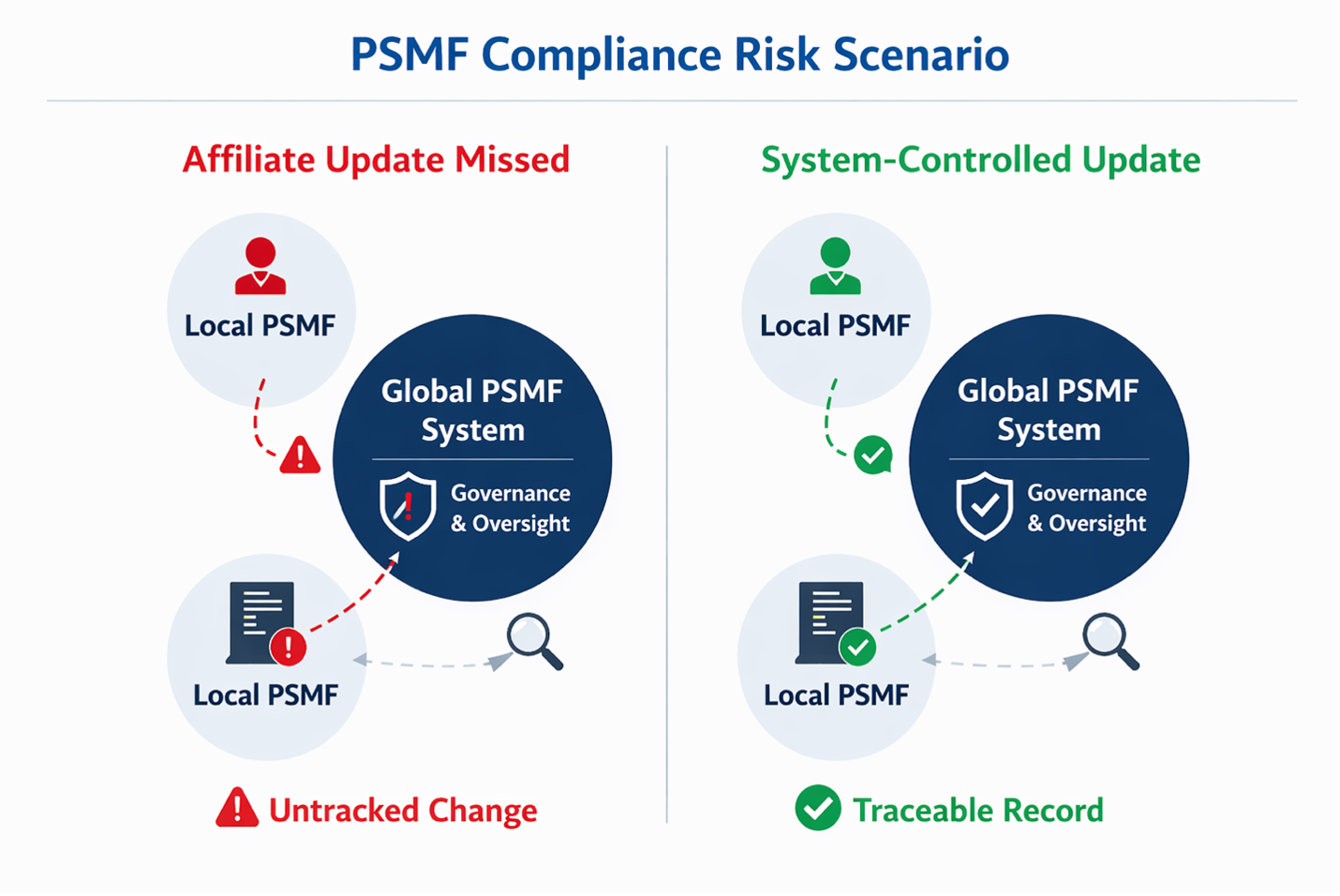
A local safety officer changes in a GCC affiliate. The update is reflected in internal HR systems and local documentation. However, the PSSF annex is not updated. The global PSMF still reflects the previous contact.
During inspection, the regulator asks for:
- Current local pharmacovigilance contact
- Evidence of oversight
- Alignment between global and local documentation
The mismatch is immediate.
The issue is not the absence of documentation. It is the absence of synchronized control.
This is where inspection findings emerge.
EMA inspection trends have repeatedly shown that PSMF-related deficiencies account for a meaningful share of major findings, particularly linked to outdated annexes and unclear system oversight.
Annex Control Determines PSMF Compliance Across Affiliates
The pharmacovigilance system master file is not static.
Its annexes change continuously, even if the main Sections narrative does not.
Product portfolios evolve, affiliates change, vendors are added or removed, Audit schedules shift.
When these updates are managed manually across affiliates, delays are inevitable.
This creates a situation where:
- Global PSMF shows one version of the system
- Local PSMF or PSSF shows another
- Internal trackers show a third
At that point, there is no single source of truth.
Maintaining consistency requires more than periodic updates. It requires controlled ownership and traceability.
This is where structured approaches to PSMF version control and governance become essential.
QPPV Oversight Must Extend Beyond the Global PSMF
The QPPV is accountable for the pharmacovigilance system as a whole.
Not just the central documentation.
This includes:
- Affiliate-level operations
- Outsourced activities
- Local compliance
In inspections, regulators assess whether the QPPV has real visibility into the system.
If annex data is outdated, if affiliate roles are unclear, or if local processes diverge from global procedures, oversight is considered ineffective.
This is not a documentation issue. It is a governance failure.
Moving from Document Coordination to System Control
The limitation of most organizations is not awareness.
It is execution at scale.
As affiliates increase, coordination becomes harder. Updates depend on communication cycles rather than system triggers. Visibility becomes fragmented.
This is why organizations are shifting toward system-driven models of PSMF management.
In these models:
- Global and local data are connected, not duplicated
- Updates follow defined ownership workflows
- Changes are recorded with full audit traceability
- The PSMF reflects the current system state at all times
Regulatory Expectations Are Expanding, Not Simplifying
Recent regulatory developments, including updates under EU Implementing Regulation 2025/1466, emphasize stronger documentation of system deviations, subcontracting transparency, and audit readiness.
At the same time, more regions are introducing local pharmacovigilance documentation requirements.
This increases complexity.
But it does not change the expectation.
Regulators still expect a single, controlled pharmacovigilance system that remains consistent across all affiliates.
What This Means for Your Pharmacovigilance System
If your global PSMF and local PSMFs are maintained separately, alignment depends on coordination.
If alignment depends on coordination, it will eventually fail under inspection pressure.
The shift required is clear.
From documents to systems.
From updates to control.
From visibility gaps to traceability.
See how a controlled PSMF system maintains alignment across global and local requirements, with real-time updates, audit trails, and inspection-ready outputs. Request Demo