
PSMF Oversight Becomes Difficult When Changes Are Scattered
PSMF oversight becomes difficult when changes are scattered across sections, annexes, source files, local requirements, and reviewer comments. The real problem is not only document volume. It is whether the PSMF still reflects the live pharmacovigilance system when it is tested during an inspection.
Industry commentary has estimated that around 28 to 32% of major PV inspection findings are linked to system governance, documentation accuracy, and oversight continuity rather than individual case-processing errors. That makes PSMF oversight a governance issue, not only a document maintenance task.(Pharmaceutical Commerce)
Under EMA GVP Module II, the PSMF describes the pharmacovigilance system and supports documentation of compliance. EMA also states that the PSMF should be permanently available for inspection and provided within 7 days when requested by competent authorities.(European Medicines Agency (EMA))
This is where AI can support PSMF teams. Not by replacing reviewers, QPPVs, or regulatory judgment, but by reducing manual review pressure and making changes easier to check before they become inspection risks.
Why PSMF Oversight Becomes Complex
A PSMF is not a static document. It changes as the pharmacovigilance system changes. Updates may come from safety databases, quality systems, vendor records, local affiliates, SOP repositories, product lists, and organizational changes.
Manual oversight often creates some problems:
| Oversight Area | Manual Risk | Inspection Concern |
|---|---|---|
| Change review | Reviewers compare long files manually | Important changes may be missed |
| Annex I | Change logs are prepared late | Change history may not reflect real-time control |
| Source alignment | Updated source files are not reflected quickly | PSMF may not match the live PV system |
| Local PSMFs | Affiliate updates are tracked separately | Global and local files may contradict each other |
| QPPV oversight | Visibility depends on emails and trackers | Oversight may be difficult to demonstrate |
When these issues build up, the PSMF may look complete on paper but still fail to show live system control. That is where inspection risk begins.

What AI Should Actually Do in PSMF Management
AI should simplify review, not create another layer of complexity.
In PSMF management, useful AI support should focus on practical documentation tasks such as:
- Checking whether a proposed change is factually supported
- Comparing updated language with source content
- Flagging mismatches or unsupported additions
- Reviewing whether content stays aligned with EMA GVP Module II expectations
- Suggesting Annex I Change Log entries
- Helping reviewers focus on what needs attention
This matches the role of Ask AI in PSMF Manager, where AI supports change reviews by checking factual accuracy, section-source consistency, regulatory alignment, and Annex I Change Log entries.
The important point is control. AI should not approve changes, publish the PSMF, or replace human accountability. It should help reviewers see risks earlier and review updates faster.
Human Review Remains Central
Regulatory-safe AI use depends on human oversight.
EMA's reflection paper on AI in the medicinal product lifecycle supports a human-centric and risk-based approach to AI use. It also places responsibility on the MAH to validate, monitor, and document AI or machine learning operations when used in pharmacovigilance.
For PSMF oversight, this means AI should act as a support layer inside a controlled workflow.
AI can suggest.
AI can flag.
AI can summarize.
AI can compare.
But the reviewer still decides whether a change is accepted, rejected, revised, or escalated.
This distinction matters because the QPPV remains responsible for oversight of the pharmacovigilance system. EMA GVP Module II states that the QPPV should be able to verify that the PSMF is an accurate and up-to-date reflection of the pharmacovigilance system under their responsibility.(European Medicines Agency (EMA))
For the QPPV, AI-supported oversight becomes useful when review status, change notifications, version history, and traceable approval activity are visible in one place instead of being scattered across emails and manual trackers.
How AI Supports Annex I Without Additional Efforts
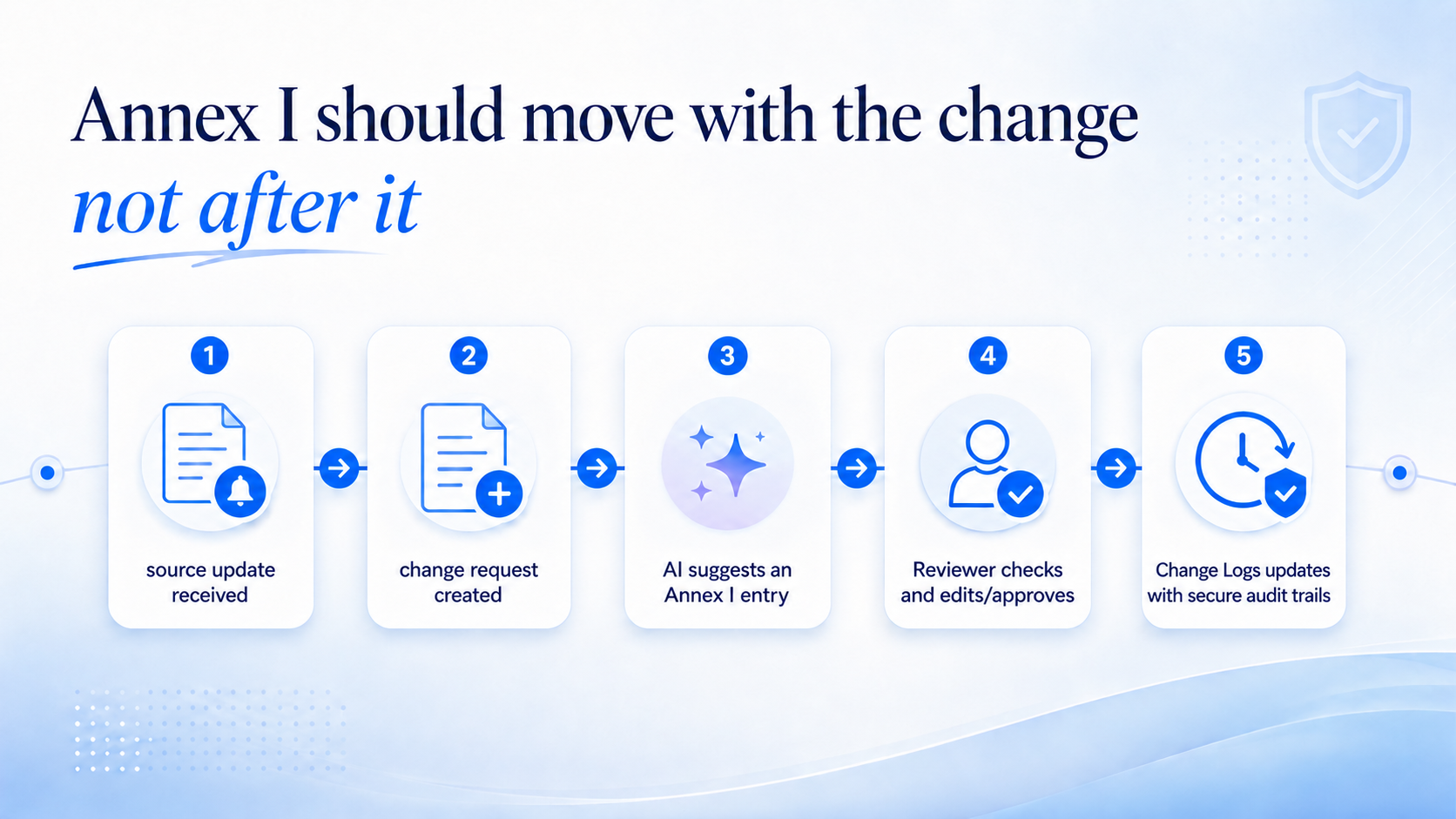
Annex I is one of the most important areas for AI-assisted review because it acts as chronological proof of system control.
If changes are made across the PSMF but the Change Log is updated later, teams may end up reconstructing history after the editing event, and that creates risk. Inspectors do not only look at the final PSMF. They look at whether the change history in Annex I shows controlled, timely, and attributable updates.
PSMF Manager's AI support feature helps by suggesting text for the Change Log fields for Annex I, coherently at the time of each change request creation. It compares edits done in changed text and/or attachments, and updates the Change Log based on the actual changes made.
This supports better contemporaneous documentation. Instead of treating Annex I as a final clean-up task, AI helps bring the Change Log upkeep into the PSMF workflow itself.
How AI Reduces Complexity Across the PSMF Lifecycle
AI becomes useful when it connects with the broader PSMF control process.
| PSMF Challenge | Without AI Support | With AI Support |
|---|---|---|
| Reviewing changes | Manual comparison across long documents | Edits are checked for accuracy, relevance, and consistency |
| Maintaining Annex I | Change Log prepared late or manually | Change Log entries are suggested contemporaneously during the workflow |
| Checking source alignment | Reviewers manually compare source files | AI highlights mismatches and unsupported updates |
| Supporting QPPV visibility | Oversight depends on follow-ups | Review status and change context are easier to see |
| Preparing for inspection | Teams scramble to explain changes | Change history, review comments, and version context remain traceable |
AI also works better when connected to controlled features like Tracked Changes, Local PSMF, and External Data Sources.
Version History preserves historical records and timestamps. External Data Sources help source updates enter a controlled review workflow instead of relying on manual monitoring.
The Right Way to Use AI in PSMF Oversight
AI should simplify PSMF oversight without weakening control. That only happens when it is used inside a structured review process, not as a separate or uncontrolled layer.
A practical AI-supported PSMF workflow should follow these principles:
| Principle | What it means for PSMF oversight |
|---|---|
| Admin-controlled use | AI should be enabled or disabled by the organization. In PSMF Manager, AI use can be switched on or off by an Admin, making it a controlled workflow feature rather than an uncontrolled add-on. |
| Review support, not approval | AI can suggest, compare, and flag issues. Human users must still decide what is accepted, rejected, revised, or escalated. |
| Traceable changes | Every accepted update should still move through controlled review, versioning, and audit trails. |
| Annex I support during the workflow | AI should help suggest Change Log entries as changes happen, not only during final PSMF generation. |
| Reduced workload without reduced accountability | AI should help reviewers focus on what needs attention while keeping ownership, approval, and documentation responsibilities clear. |
AI should not be used to bypass review, approve regulatory content automatically, or make unsupported changes to the PSMF. It should also not be used when source data is incomplete, ownership is unclear, or the organization has not defined who reviews, approves, and documents AI-supported suggestions.
For regulated teams, AI-supported workflows should also sit within a validated software environment. This means AI support should be governed through role-based access, audit trails, documented configuration, and risk-based validation principles such as GAMP 5 where applicable. PSMF Manager's Compliance & Security framework references EMA GVP Module II, US FDA 21 CFR Part 11, GAMP 5, EU GMP Annex 11, audit trails, role-based access control, encryption, and secure cloud infrastructure.
AI should support the review workflows before PSMF Generation, not the generation process itself. It helps speed up factual checks, source alignment, change review, and Annex I preparation so approved content is ready for controlled PSMF Generation.
A Simpler Model for Inspection-Ready Oversight
AI simplifies PSMF oversight when it helps teams move from reactive review to controlled review.
The goal is not to make the PSMF "AI-managed." The goal is to make the PSMF easier to keep accurate, current, traceable, and ready for inspection.
With Ask AI, PSMF Manager helps PV teams review changes, support Annex I maintenance, check internal consistency, and keep human approval at the center of the process.
For teams managing complex PSMF documentation across global and local systems, this is where AI becomes useful. It removes avoidable manual friction while keeping the governance trail visible.
See how PSMF Manager's Ask AI supports controlled change review, Annex I maintenance, and inspection-ready PSMF documentation. Request a demo