
A PSMF Compliance Failure Points to Something Bigger
A PSMF compliance failure is rarely just a missing document issue.
It usually points to something bigger: the documented pharmacovigilance system may not match the live system.
That is why PSMF failures can become costly quickly. They can lead to inspection findings, urgent remediation, repeated data checks, QPPV pressure, affiliate follow-ups, and deeper questions about governance.
Under EMA GVP Module II, the PSMF should describe the pharmacovigilance system and support documentation of compliance. EMA also states that the PSMF should be permanently available for inspection and provided within 7 days when requested by competent authorities.
A weak PSMF does not only delay response. It can signal weak control.
Industry commentary has also noted that PSMF issues are often linked to major findings because they point to weak governance, poor documentation accuracy, or gaps in oversight continuity rather than a simple documentation issue.
Why a PSMF Failure Costs More Than an Inspection Finding
The visible cost is the inspection finding.
The hidden cost is the operational effort that follows.
When a PSMF is outdated or inconsistent, teams may need to:
- Reconstruct change history
- Verify old source files
- Recheck annexes
- Confirm vendor and affiliate responsibilities
- Correct outdated SOP references
- Prepare CAPA evidence
- Involve QPPV, QA, regulatory, and PV operations at once
The PSMF often becomes an inspection map. If that map is incomplete, inspectors may expand their questions into the wider PV system.
The case involving a major pharmaceutical company highlights how serious weak pharmacovigilance system controls can become. In 2012, the EMA stated that inspectors identified around 80,000 reports that had not been evaluated to determine whether they should be reported as suspected adverse reactions, including 15,161 reports involving patient deaths, while also noting that causality had not been established.
The lesson for PSMF teams is simple: documentation control is part of system control.
Where PSMF Compliance Failures Usually Start
PSMF failures often begin in predictable areas.
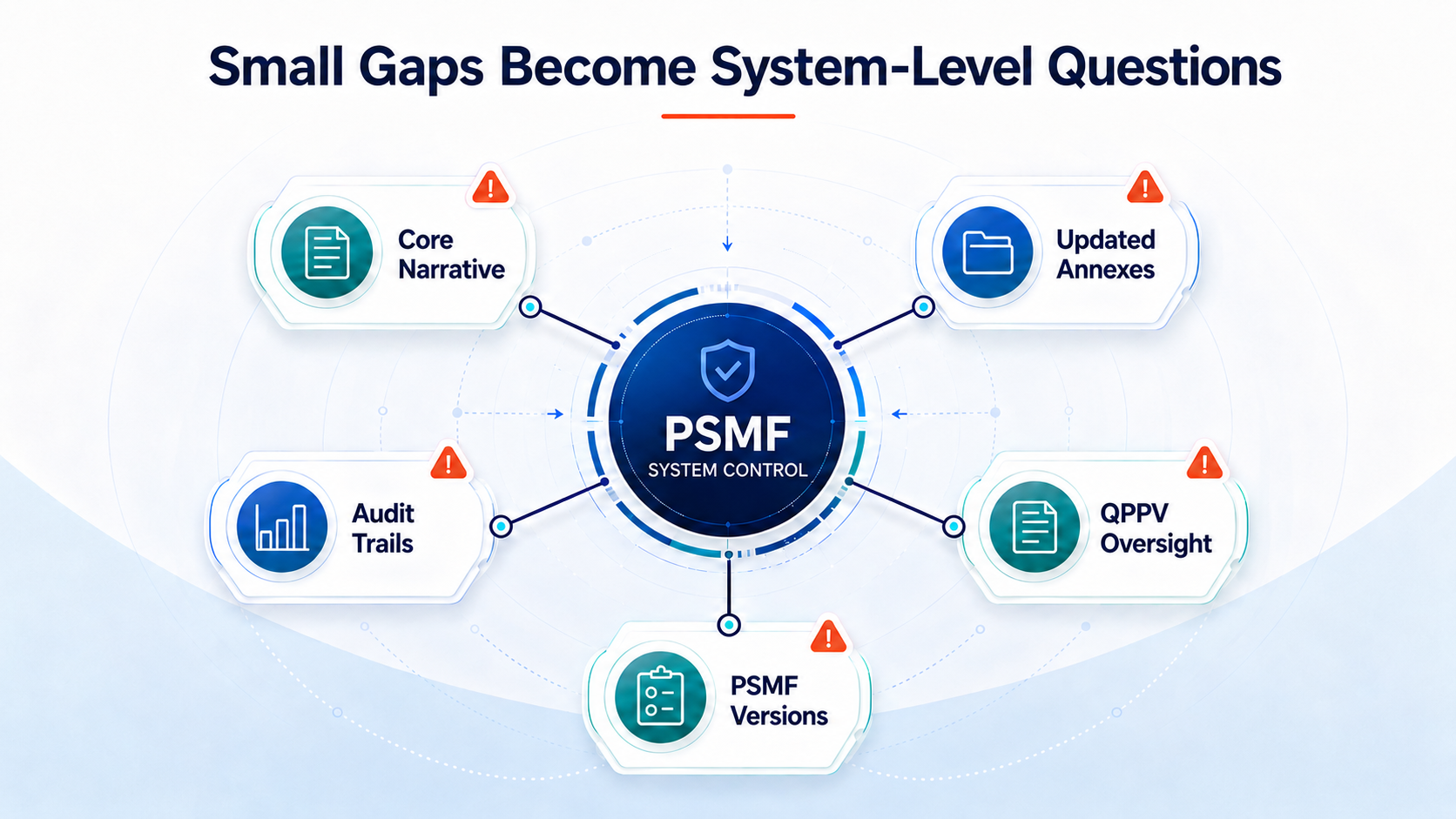
Core narrative
Does the PSMF still describe the live PV system, or does it reflect an old structure?
Annex B
Are the vendor, affiliate, and subcontractor responsibilities clear and up to date?
Annex C
Are the safety data sources and contact details complete and up to date?
Annex G
Are audits risk-based, documented, and followed through?
Annex I
Are system changes captured when they happen, or reconstructed later?
Recent industry analysis notes that avoidable PSMF inspection concerns often arise from annex-level weaknesses, including missing or unclear agreements, missing safety data source contacts, inadequate audit planning, and system changes not captured in the logbook.
These gaps may look small at first. During inspection, they can become system-level questions.
The 7-Day Request Turns Weak Control Into Visible Risk
The 7-day request window exposes whether the PSMF is truly controlled.
If teams need to search folders, check spreadsheets, compare versions, and ask affiliates for confirmation after the request arrives, the risk is already visible.
The real question is not:
"Can we create the file in 7 days?"
The better question is:
"Was the PSMF already current before the request?"
A controlled PSMF should make it easier to show which version was active, what changed, who approved it, and whether the document reflects the current PV system.
For the QPPV, this matters because weak visibility into pending changes, affiliate updates, or outdated annexes can make oversight harder to demonstrate when inspectors start asking follow-up questions.
How to Avoid the Cost of PSMF Failure
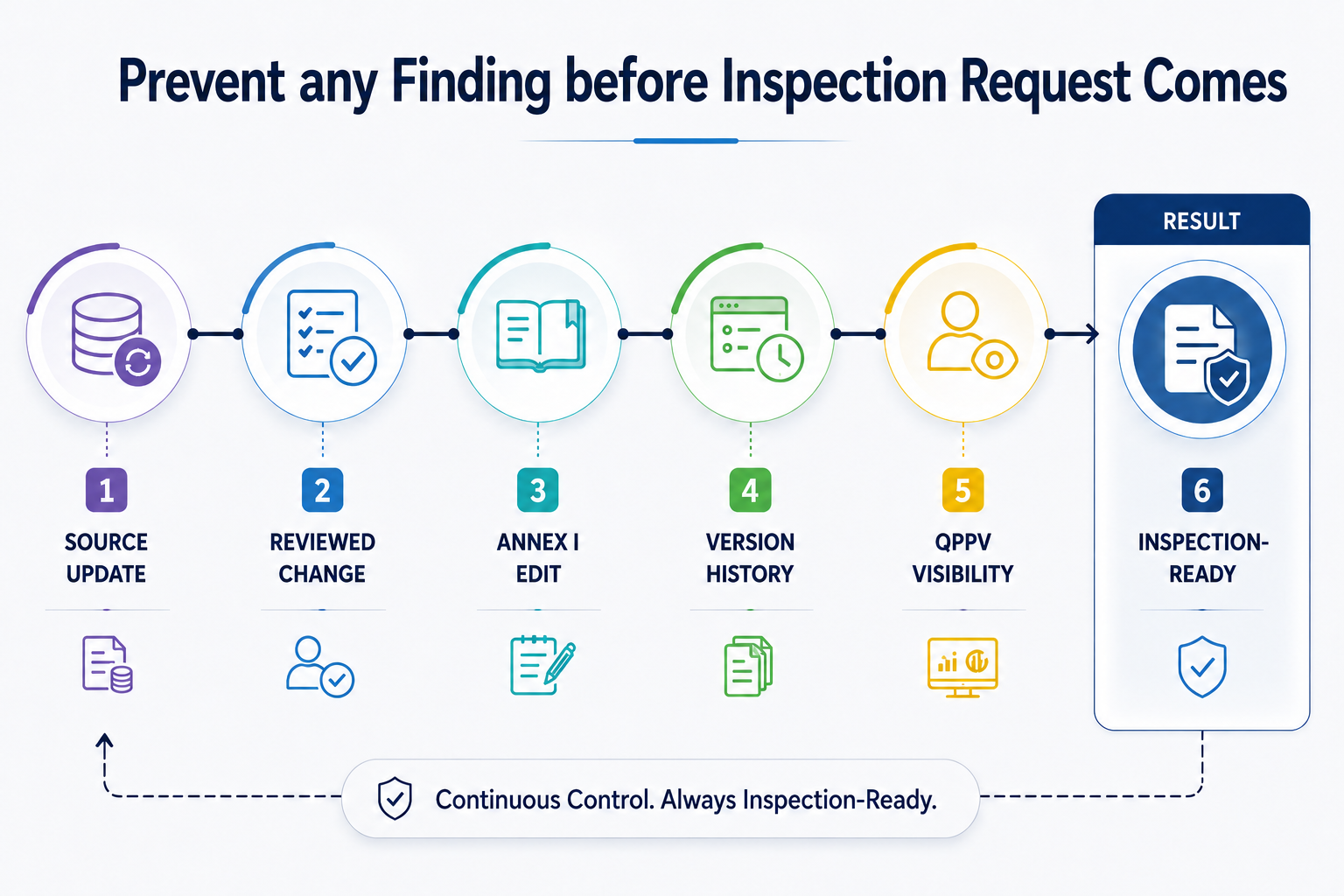
The best way to reduce PSMF failure risk is to maintain control continuously.
Focus on these five areas:
1. Keep version history complete
Teams should be able to retrieve previous PSMF versions and show what changed over time.
2. Treat Annex I as live evidence
Change logs should move with system changes, not be updated at the end.
3. Connect source updates to review
Updates from vendors, affiliates, SOP repositories, audits, and safety data sources should trigger review soon after the updates occur to help prevent the PSMF from falling behind.
4. Maintain clear ownership
Each section/annex of the PSMF should have defined owners, review timelines, and approval responsibility.
5. Preserve audit trails and QPPV visibility
The QPPV should be able to have a holistic overview of the pending changes, approved updates, and documentation history before inspection pressure begins.
How PSMF Manager Helps Reduce Compliance Risk
PSMF Manager helps PV teams reduce manual gaps by connecting PSMF control to structured workflows.
- Version History supports historical retrieval and audit trails with time-stamped accountability.
- Tracked Changes helps reviewers see exactly what was changed, who made the change, and how the review moved forward.
- External Data Sources help source updates move into controlled review instead of staying in disconnected systems.
- Global and Local PSMFs support central and affiliate alignment when regional requirements differ.
- PSMF Generation helps generate structured PSMF outputs from approved content, with accurate change logs in Annex I.
Prevention Costs Less Than Remediation
The true cost of a PSMF compliance failure is not only the finding. It is the time, pressure, rework, and loss of confidence in the PV system that follows.
A controlled PSMF keeps teams in a better position before inspection pressure begins.
It helps prove that the PV system is current, traceable, and governed.
PSMF compliance failures are easier to prevent when documentation control is continuous, not reactive. See how PSMF Manager helps PV teams maintain version history, annex control, source updates, and inspection-ready records. Request a demo