The Tools Still Work. Everything Around Them Has Changed.
The Excel tracker still works. The Word document is still editable. The team is still getting the PSMF updated.
What changes is everything around them.
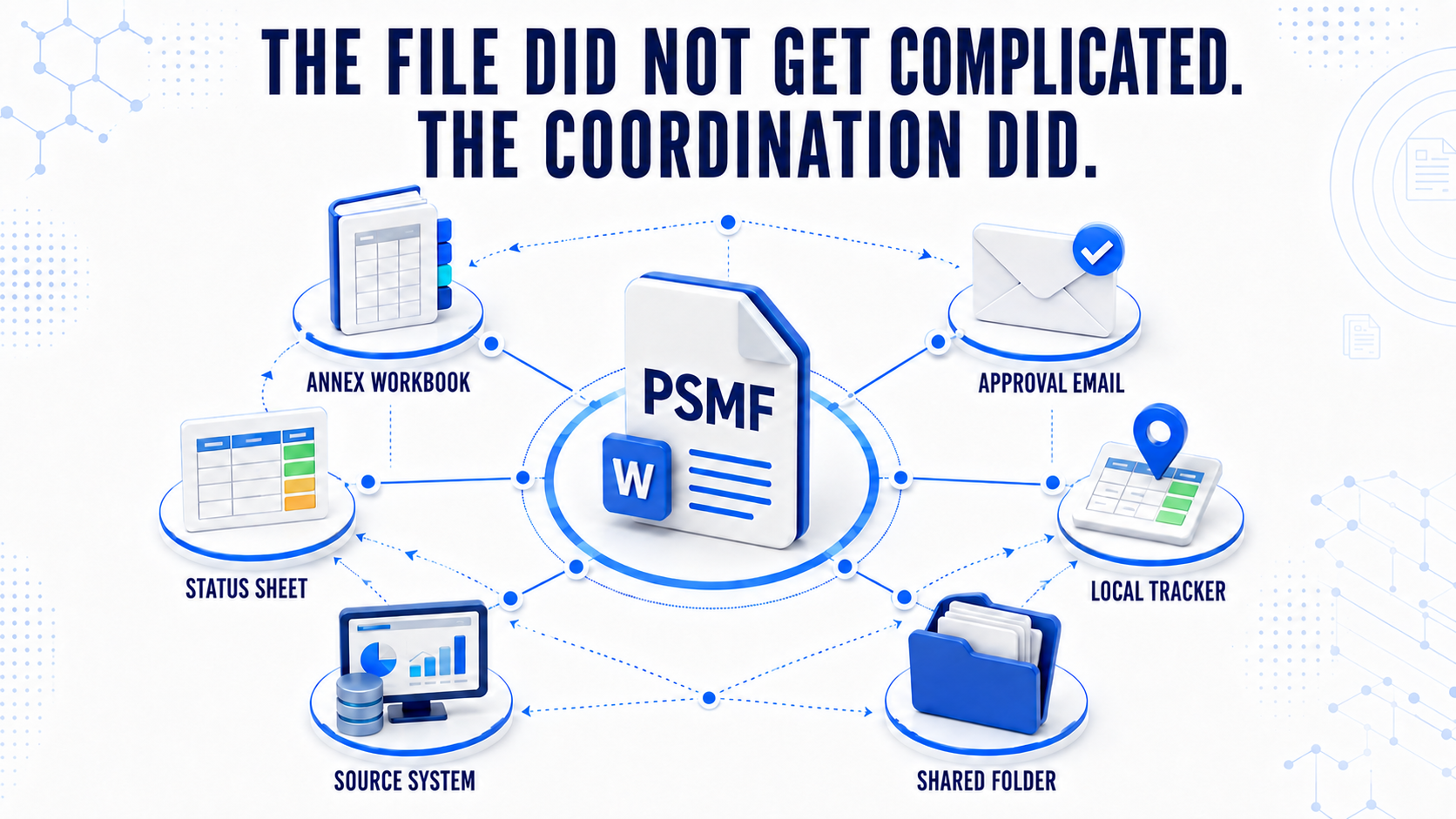
One tracker becomes four. One reviewer becomes six. A global PSMF is joined by several local files. Approvals sit in email. Annex information lives in separate spreadsheets. One person gradually becomes the only person who understands how everything connects.
That is when the question changes from:
“Can we manage the PSMF manually?”
to:
“How much manual coordination does it now take to prove that the PSMF is controlled?”
Key Takeaway: Word and Excel can support PSMF management. The warning sign is when control starts depending on more trackers, more handoffs, and more individual knowledge as the pharmacovigilance system grows.
Manual Does Not Mean Non-Compliant
Neither EMA GVP Module II nor any of the EU legislations requires an MAH to purchase dedicated PSMF software. EMA guidance allows electronic PSMF storage provided records remain readable over time and can be produced for audit and inspection. The PSMF and its Annex must also remain under version control, with records indexed and archived for accurate retrieval.
So the problem is not the documents themselves.
The question is whether the control model built around them still scales.
9 Signs the Operating Model Is Starting to Strain
1. Nobody Can Confirm the Approved Version Without Checking More Than One Place
If the answer requires a folder, version tracker, and approval email, the current state is being maintained through coordination rather than one controlled record.
Version control becomes increasingly difficult as contributors and revisions grow.
2. Approval Evidence Is Scattered Across Files, Emails, and Trackers
The author updates the document. A reviewer comments. Approval comes by email. Someone updates the tracker.
The concern is not whether each step happened. It is whether the team can later show exactly which content was reviewed and approved without manually reconstructing the sequence.
3. The Annexes Have Developed Their Own Management System
Product lists, vendors, audits, performance information, and Change Logs may each sit in different spreadsheets.
At that point, the PSMF is already a network of records that must be manually synchronized.
4. Source Changes Depend on Someone Remembering to Tell the PSMF Team
A vendor changes. An SOP is revised. A database is upgraded.
If the PSMF team finds out only when someone remembers to send an email, every additional source creates another possible break in the process.
A structured system can instead bring relevant source changes into a managed assessment workflow.
5. You Can Find Today's PSMF, but Reconstructing History Takes Work
Finding the latest file is one question.
Answering questions during an inspection like what the approved PSMF looked like six months ago, what changed after that, and who acted on the change is another.
EMA guidelines require PSMF version control and ready retrieval of records. For more on this distinction, see PSMF Version History vs Audit Trail.
6. One Global Change Creates Several Manual Local Follow-Ups
A global change may affect different local PSMFs in different ways.
When each market adds another spreadsheet row, reminder, reviewer, and status check, the global-local relationship is scaling manually.
PSMF Manager's Global and Local PSMFs capability is designed to centralize these relationships within the PSMF workflow.
7. QPPV Oversight Has Become a Reporting Exercise
If the QPPV wants to know what is pending today, can the workflow show it?
Or must someone prepare a tracker, summarize emails, and explain what still needs review?
When oversight depends on someone creating a separate status report, the workflow itself may no longer provide enough visibility.
8. Final PSMF Generation Is Still a Publishing Project
If every final version requires manual merging, Annex checks, formatting, bookmark creation, Change Log confirmation, and PDF preparation, generation is still absorbing work that sits outside the controlled review process.
PSMF Manager includes dedicated PSMF generation alongside version history, tracked changes, external data sources, and global/local PSMF controls.
9. The Process Depends on One or Two People Knowing How Everything Connects
This is often the clearest sign.
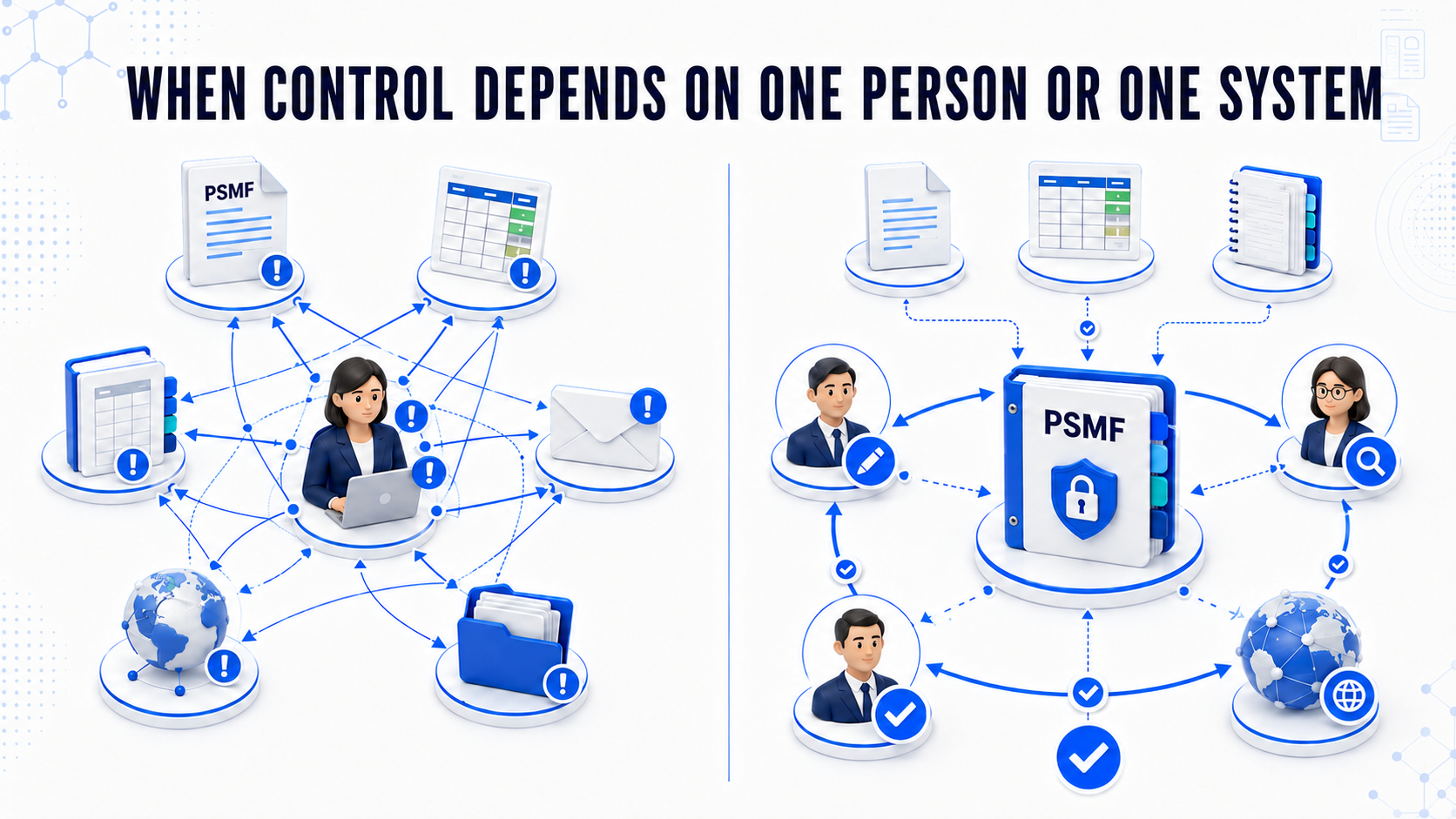
If one coordinator knows which tracker matters, where the approval sits, which Annex needs updating, and who still owes a response, the control is partly living in that person's head.
The Two-Week Absence Test
Imagine the main PSMF coordinator is unavailable for two weeks.
Can another qualified team member immediately:
- Find the current approved PSMF?
- See all pending changes?
- Identify what needs review?
- Retrieve the previous version?
- Explain the latest Change Log entry?
- Produce the current file?
If the answer to all the above questions is undoubtedly yes, the manual model may still be working well.
If the answer is “only one person knows how that works,” the problem is no longer the information. The process has become person-dependent.
When Staying Manual Can Still Make Sense
Manual PSMF management may remain proportionate when the portfolio is stable, change volume is low, contributors are limited, approvals are clear, historical records are easy to retrieve, and the process continues to work without a few key personnel.
An ePSMF does not automatically make a PSMF compliant.
It becomes worth evaluating when several of these nine signs become normal and the team spends more effort coordinating the controls around the PSMF than maintaining the PSMF itself.
When Control Needs to Scale With the PSMF
If several of these signs are appearing together, the issue is no longer whether the PSMF can be stored.
It is whether the surrounding control model can continue to scale with the number of changes, contributors, markets, and source systems.
That is where a structured ePSMF becomes less about replacing documents and more about reducing the manual coordination around them.
PSMF Manager brings global and local PSMFs, version history, tracked changes, external data sources, controlled generation, and PSMF workflows into one dedicated environment.
Request a Demo to see how PSMF Manager can support the move from manual coordination to a structured ePSMF workflow.