A Proposed Update Arrives. Someone Still Has to Judge It.
A proposed PSMF update arrives with revised text and supporting documents.
The change looks reasonable. But a reviewer still needs to ask: Does the wording match the source? Has anything important been left out? Has the change moved beyond its original scope? Does Annex I tell the same story?
This is where AI can be useful.
Not by making the decision, but by helping the reviewer see what deserves attention before a decision is made.
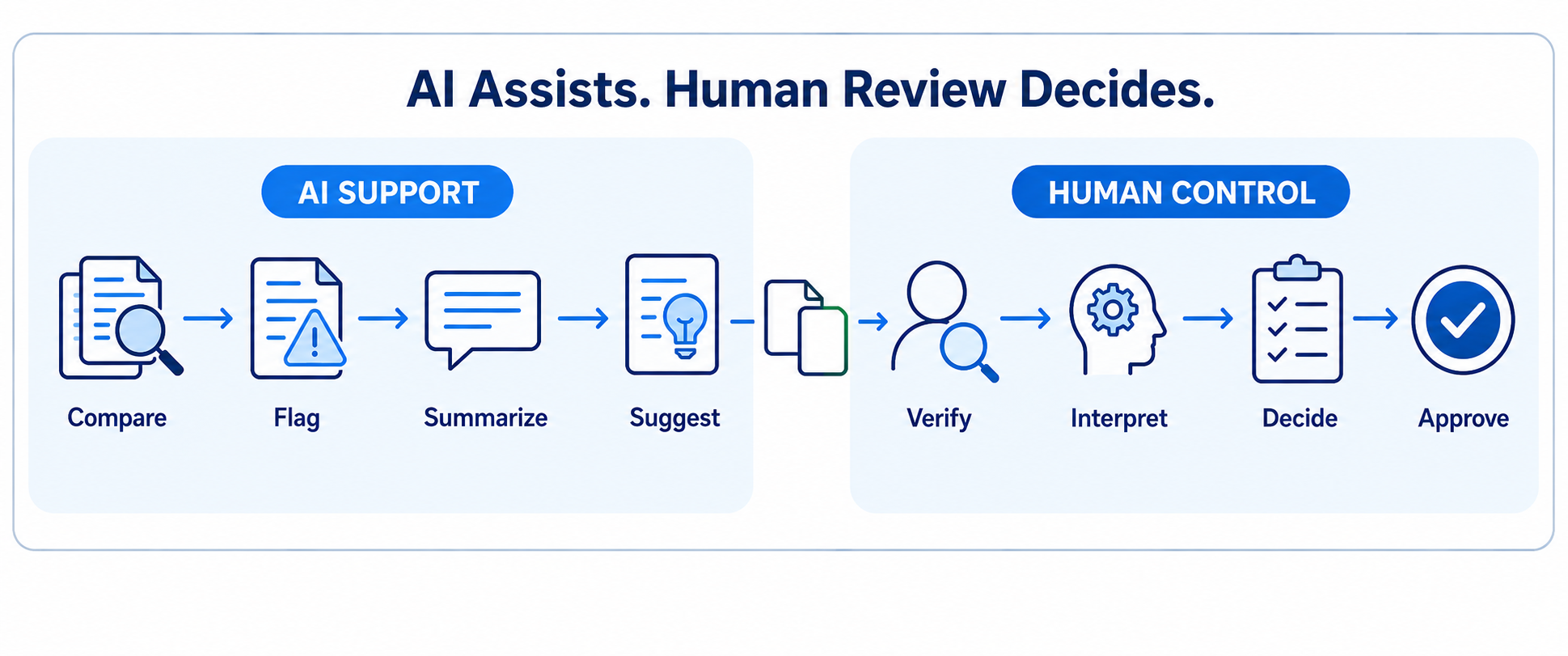
Key Takeaway: AI works best in PSMF review when it compares, flags, summarizes, and suggests. Human reviewers should still verify, decide, and approve. The goal is faster review without losing clear ownership of the decision.
Good AI Support Starts With a Clear Boundary
EMA's adopted reflection paper on AI covers the medicinal-product lifecycle through the post-authorisation setting and supports a human-centric approach to AI use. In January 2026, EMA and FDA also published ten common principles for good AI practice, including human-centric design, a risk-based approach, clear context of use, data governance, performance assessment, and lifecycle management.
For PSMF review, the principle can be kept simple:
AI moves the review forward. The human owns the decision.
That boundary matters because the MAH remains responsible for the completeness and accuracy of the PSMF, including where pharmacovigilance activities are delegated.
Six Places Where AI Can Help Without Taking Control
| Sr. No. | Review Situation | AI Can Help With | Human Oversight Remains With |
|---|---|---|---|
| 1 | When two records no longer tell the same story | Flagging possible inconsistencies between proposed PSMF content and supporting information | Confirming which information is correct and what should change |
| 2 | When the draft needs to be checked against its source | Comparing proposed wording with source text and highlighting mismatches or unsupported additions | Verifying the source and accepting, rejecting, or revising the wording |
| 3 | When something important may have been missed | Highlighting possible omissions, missing context, or information that may require further assessment | Deciding whether the information is relevant and whether PSMF action is required |
| 4 | When the reviewer needs to find the important changes first | Summarizing concerns and drawing attention to areas that may need closer review | Assessing the material changes and deciding what requires action |
| 5 | When Annex I needs to move with the change | Suggesting Change Log wording based on the change being reviewed | Checking and approving the final Annex I entry |
| 6 | When an approver needs the change explained clearly | Summarizing what changed and identifying review points | Making the final approval decision |
These uses closely match the current role of Ask AI in PSMF Manager, which supports factual checks, source comparisons, scope review, reviewer comments, and Annex I Change Log suggestions. PSMF Manager explicitly keeps acceptance, rejection, and approval with human users.
Annex I Is Where AI Assistance Becomes Especially Practical
Change Log maintenance is a good example of where AI can reduce manual effort without taking ownership away from the reviewer.
Rather than preparing Annex I wording during finalisation, AI can suggest the Change Log entry while the change is being managed. If the underlying edit changes, the proposed entry can also be updated for review.
The important control remains unchanged:
The reviewer checks, edits where needed, and approves the entry before it becomes part of the controlled PSMF record. PSMF Manager's annex workflow follows this human-review model.
This is also relevant as Regulation (EU) 2025/1466 now requires major or critical deviations from pharmacovigilance procedures, their impact, and their management to be documented in the PSMF until resolved.
The Risk Begins When Assistance Becomes Authority
AI should not independently:
- Approve a PSMF change
- Decide that the PSMF is compliant
- Replace reviewer or QPPV judgment
- Turn assumptions into approved content
- Create missing evidence
- Publish a final change without human review
This distinction is important because AI output can sound confident even when it needs correction.
A strong process therefore treats AI output as review input, not evidence by itself.
The reviewer still needs to understand the PSMF context, the regulatory requirement, and the effect of the proposed change.
For related guidance, see PSMF Change Tracking and AI and PSMF Oversight.
The Better Question Is Not “How Much Can AI Do?”
A useful AI-supported workflow should make expert review clearer, not less visible.
When a change reaches approval, the record should still make it clear what was reviewed, what action was taken, and who made the final decision.
That is the stronger model for AI-assisted PSMF review:
AI helps find the issue. A person decides what it means. The controlled workflow preserves what happened.
See AI-Assisted Review Inside the PSMF Workflow
PSMF Manager's Ask AI supports change review and Annex I maintenance inside a controlled PSMF workflow, while final decisions remain with human users.
Request a Demo to see how AI-assisted PSMF review works in practice.