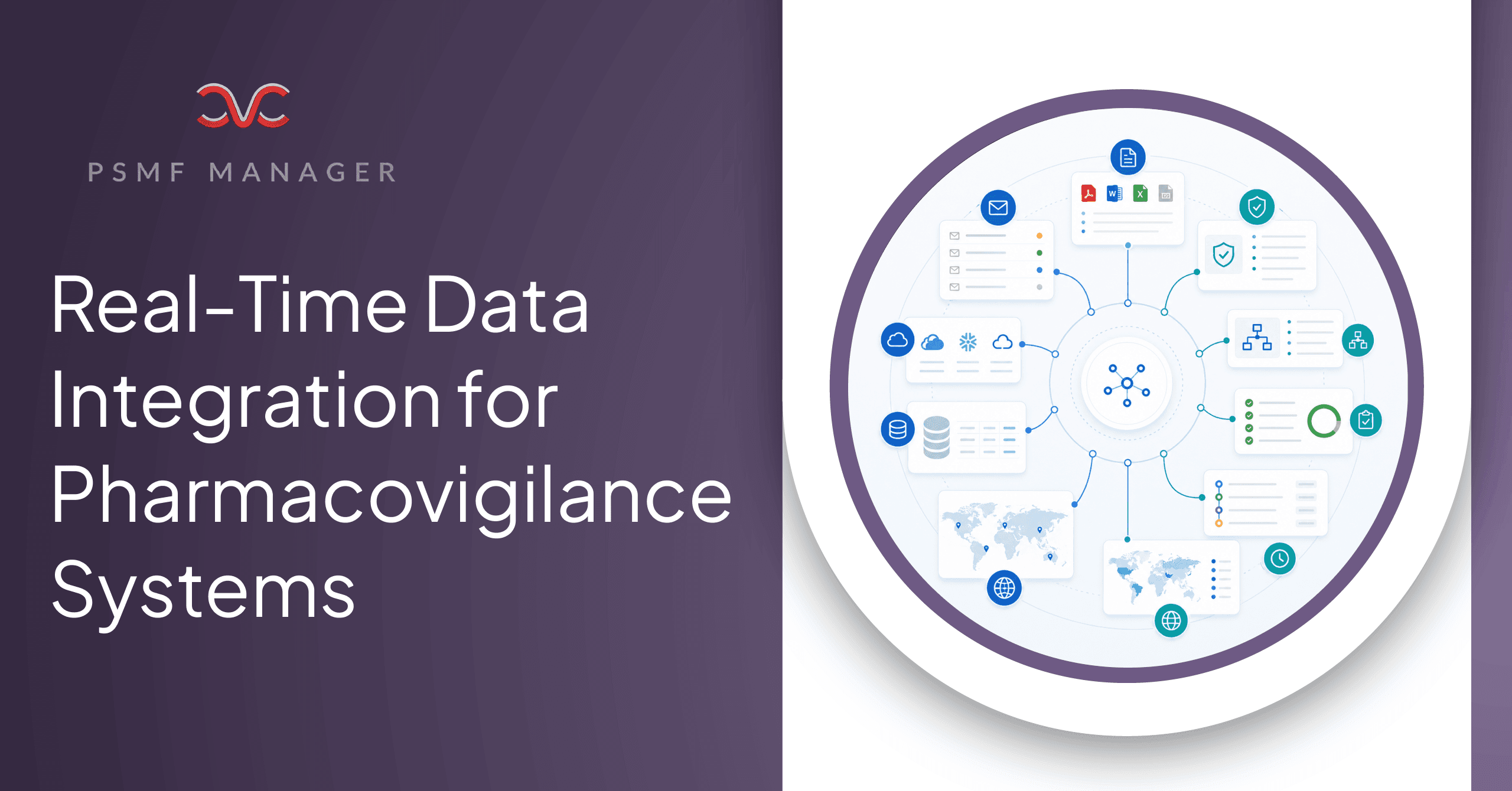
Disconnected Systems Create Documentation Gaps
Pharmacovigilance systems do not stay still. Product information changes. SOPs are updated. Vendor responsibilities shift. Safety data sources evolve. Audit and CAPA records move forward. Local affiliates add new inputs.
The problem is that many PSMF workflows still depend on periodic checks, emails, shared folders, and manual trackers. By the time a team notices that source data changed, the PSMF may already be behind the live pharmacovigilance system.
That creates inspection risk.
Under EMA GVP Module II, the PSMF must describe the pharmacovigilance system and support documentation of compliance. It includes areas such as safety data sources, computerized systems, pharmacovigilance processes, system performance, quality systems, annexes, change control, versions, and archiving. This makes current source data essential to PSMF control.
Real-time data integration is critical because it reduces the gap between what changed in the source system and what enters the PSMF review workflow.
Pharmacovigilance Systems Depend on Many Moving Data Sources
A pharmacovigilance system pulls information from multiple teams and systems. That may include but is not limited to:
- Safety databases
- Quality management systems
- Document management systems
- Regulatory systems
- SOP repositories
- Vendor and subcontractor records
- Affiliate inputs
- Audit and CAPA records
- Product and license data
- Reporting metrics
EMA GVP Module I also makes it clear that the pharmacovigilance quality system covers organizational structure, responsibilities, procedures, processes, resources, compliance management, and record management. It also states that the QPPV should have access to the PSMF and be able to verify that it is accurate and up to date.
This is why integration matters. If the systems feeding PSMF content are disconnected, the PSMF can become outdated even when each department is updating its own records correctly.
The Risk of Delayed Source Updates
When source data changes in one system but the PSMF remains unchanged, the organization creates a gap between the live PV system and the documented PV system.
That gap may show up as:
| Area | Risk When Updates Are Delayed |
|---|---|
| SOP references | Old procedures remain in the PSMF |
| Vendor records | Partner or subcontractor changes are missed |
| Product data | Annexes do not reflect the current product scope |
| Safety data sources | Data flow descriptions become outdated |
| Audit and CAPA records | Quality system oversight is not current |
| Annex I | The change history is updated late or reconstructed |
This is especially important because the PSMF is not just a reference file. It is used to understand how the pharmacovigilance system is structured, controlled, and maintained.
Why 2026 Raises the Pressure on Data Integration
Real-time integration is becoming more important as pharmacovigilance expectations move toward stronger system governance and traceability.
EU Regulation 2025/1466 updates pharmacovigilance requirements and increases the focus on documented control across PV activities, including outsourced and subcontracted responsibilities. For PSMF teams, this means vendor records, audit information, deviation status, CAPA updates, and source-system changes cannot remain scattered across disconnected files.
The PSMF needs to show that the documented system is close to the live PV system. Real-time integration helps by bringing source updates into a controlled review workflow before they create outdated annexes, missed Change Log entries, or weak oversight evidence.
What Real-Time Integration Should Actually Do
Real-time integration should enable controlled synchronization between external source systems and the PSMF. The purpose is not only to detect that a source file has changed, but to make sure that the update is reflected in the PSMF workflow with traceability.
Depending on the organization's configuration, integration can support two types of control:
- Review-based updates, where a source change is detected, logged, and routed to responsible users for review before it is reflected in the PSMF.
- Auto-annex updates, where updated files from an external system directly update the relevant PSMF annex with associated audit trails and archived previous files.
A good integration workflow should:
- Detect a new or revised source file
- Notify the right users where review is required
- Raise a review item when the workflow is configured for approval-based updates
- Support direct annex updates where auto-annex automation is enabled
- Preserve all previous files
- Log the update in an audit trail
- Maintain traceability between the external source update and the corresponding PSMF annex
PSMF Manager's External Data Sources feature supports this logic. Source updates can raise corresponding review changes, real-time audit trails can log updates, previous files can be archived, and users can receive instant notifications when integrated source files are updated.
Where configured, the auto-annex capability also allows updated files from external systems to directly update the corresponding annex in the PSMF. This helps reduce delays caused by repeated manual attachment, while still maintaining audit trails, archived previous files, and traceable update history.
That makes integration a governance function, not just a data transfer feature.

How Integration Supports QPPV Oversight
QPPV oversight depends on visibility.
If source updates remain buried in emails, local folders, vendor communications, or separate trackers, the QPPV may not have a clear view of what changed, what is pending review, and whether the PSMF still reflects the current PV system.
Real-time integration helps by making source changes visible earlier.
For the QPPV, this can support:
- Visibility into pending PSMF-related changes
- Faster identification of outdated source files
- Clearer review and approval status
- Better traceability of source updates
- Stronger evidence of continuous oversight
This matters because the QPPV should have access to the PSMF and be able to verify that it accurately reflects the pharmacovigilance system under their responsibility. Real-time integration supports that expectation by making source changes, pending reviews, approvals, and audit trails easier to see before they become inspection issues.
Why Real-Time Integration Matters Beyond the PSMF
Real-time integration also supports broader PV maturity. Signal management, safety monitoring, quality oversight, and regulatory reporting all depend on timely and reliable information.
Regulators are also moving toward more structured data use. FDA's Sentinel Initiative, EMA's DARWIN EU, FDA's 2024 real-world data guidance, and the 2026 E2B(R3) requirement all point in the same direction: cleaner data, better interoperability, and stronger traceability.
For PSMF control, the principle is simple. Source information should be easy to detect, review, trace, and reflect accurately in the documented PV system.
Where Real-Time Data Integration Helps Most
Real-time integration is most useful where delays create documentation or oversight risk.
| Area | Manual Risk | Integration Benefit |
|---|---|---|
| Source data | Change is found late | Update is incorporated directly or routed for review based on the configured workflow |
| SOP references | Old SOP remains in the PSMF | The updated file is flagged or reflected in the relevant annex |
| Vendor records | Agreement changes are missed | Responsible users are alerted, and the updated source file remains traceable |
| Annex I | Change Log updated late | The change event is captured along with the source update |
| Version history | The previous state is unclear | Prior files and update actions are preserved |
| QPPV oversight | Visibility depends on follow-up | Overview enables easier monitoring of source updates, review status, and annex changes |
The key point is not speed alone. The real value is controlled visibility. Integration helps teams know what changed, where it came from, how it was handled, and whether the PSMF annex has been updated through the correct workflow.
Why Integration Does Not Mean Losing Control
Some teams hesitate to integrate source data because they worry it may reduce control over the PSMF.
That concern is valid if integration is poorly configured or if updates happen without traceability. But direct updates are not the problem. Uncontrolled updates are the problem.
A well-designed integration workflow can support both review-based updates and auto-annex updates without weakening governance. In both workflows, change logs can also be saved at the end of the update within the relevant files, so the update record remains clear, traceable, and available for review.
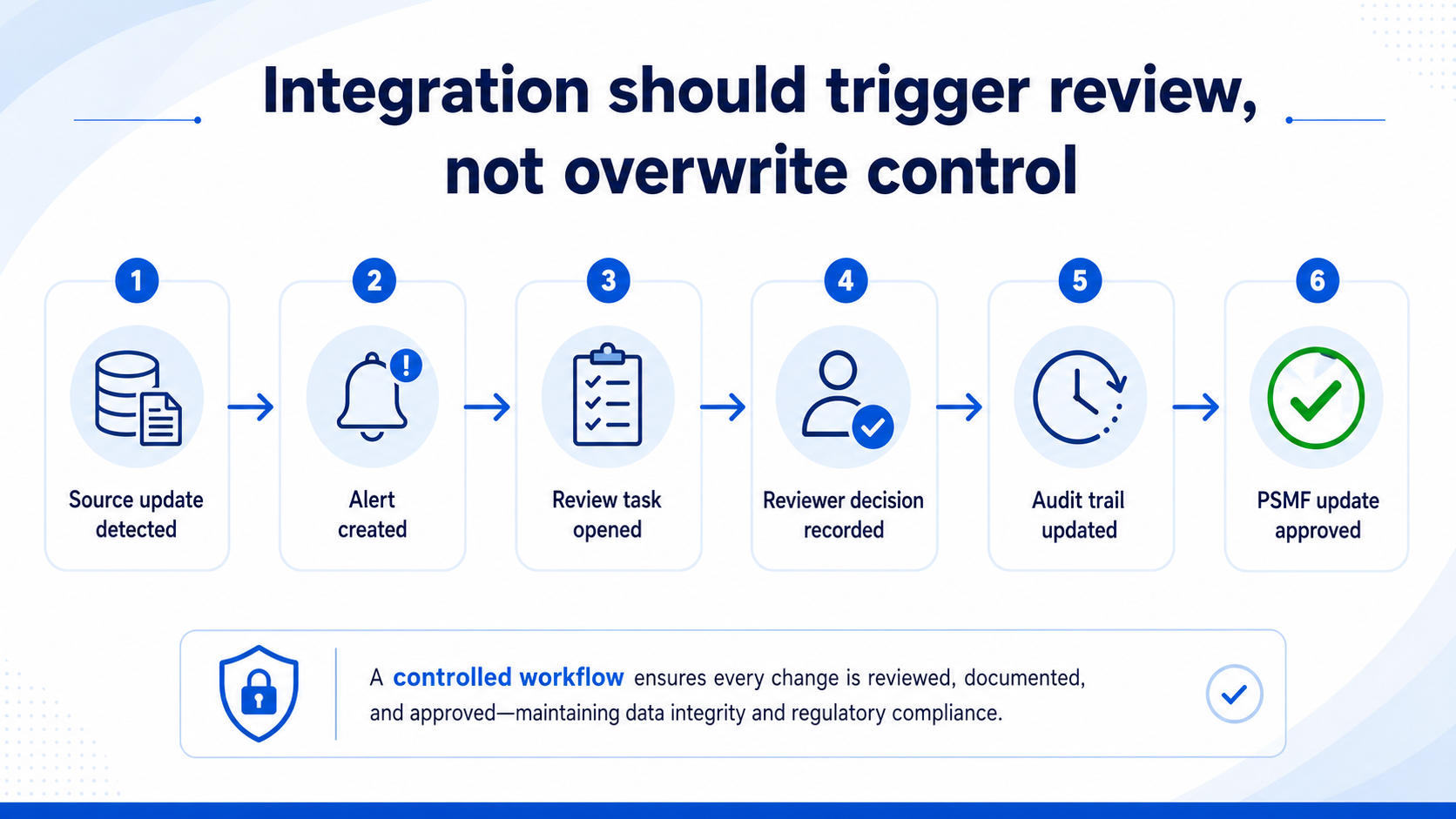
In a review-based workflow:
- The source update is detected
- A review task is created
- The responsible user checks the change
- The reviewer approves or rejects the update
- The audit trail records the action
- The PSMF content is updated through a controlled workflow
In an auto-annex workflow:
- The updated file is detected in the external system
- The relevant PSMF annex is updated automatically
- The previous file is archived
- The audit trail records the update
- The update remains traceable for oversight and inspection purposes
This keeps automation aligned with control. The organization can decide whether an update needs review before it is reflected in the PSMF, or whether the update can flow directly into the relevant annex through a configured auto-annex process.
The important point is that every update should remain attributable, traceable, and visible.
How PSMF Manager Supports Real-Time Data Integration
PSMF Manager supports real-time data integration by helping external source updates stay connected to controlled PSMF documentation.
External Data Sources help identify source updates, trigger notifications, archive previous files, and maintain real-time audit trails. Depending on the configured workflow, updates can either be routed for review or directly reflected in the relevant PSMF annex through the auto-annex capability.
Tracked Changes helps reviewers see what changed, who made the change, and how the review moved forward when review-based workflows are used.
Version History supports retrieving historical PSMF versions, timestamps, user details, and change descriptions, which is important during audits and inspections.
Together, these features help PV teams reduce manual monitoring, improve visibility, and keep PSMF documentation closer to the live PV system without losing traceability.
Keep the Documented System Close to the Live System
Real-time data integration is critical because pharmacovigilance systems change continuously.
If source updates are delayed, the PSMF can fall behind. If updates are handled without traceability, control can weaken. The right approach is integration with governance.
Source updates should be detected early and handled through the correctly configured path. Some updates may be routed for review before being reflected in the PSMF. Others may directly update the relevant annex through the auto-annex feature, with audit trails and archived previous files maintained.
That is how PV teams reduce documentation gaps, support QPPV oversight, and stay better prepared for audits and inspections.
See how PSMF Manager helps PV teams connect external data sources to controlled PSMF workflows, auto-annex updates, audit trails, and inspection-ready documentation. Request a demo