
An Inspection Request Arrives. Then Come the Questions.
An inspection request arrives. The current PSMF is needed.
Then come the questions.
Which version was active when a change occurred? Who reviewed it? When was it approved? What changed from the previous version? Can that earlier version still be retrieved?
When PSMF management depends on Word files, spreadsheets, emails, and shared folders, these questions can quickly turn into a search across several systems.
PSMF management software should make that process easier by bringing updates, reviews, approvals, change history, generation, and retrieval into one controlled environment.
Key Takeaway: The right PSMF system should help your team show what changed, who reviewed it, what was approved, and what the PSMF showed at a specific point in time. The real comparison is not feature count. It is control, traceability, and inspection readiness.
A Current PSMF Is Not Enough. The Evidence Behind It Matters.
EU requirements state that PSMF information must be accurate and reflect the pharmacovigilance system in place. The PSMF and its Annex must also be subject to version control. EMA states that the PSMF should remain permanently available for inspection and should be provided within seven days when requested.
There is also an important change that recently came into effect. Regulation (EU) 2025/1466 has applied since 12 February 2026. It narrowed the earlier deviation requirement so that major or critical deviations, their impact, and their management are documented in the PSMF until resolved.
So the practical question becomes:
Can the current system being followed provide clear and traceable evidence without your team having to rebuild the story manually?
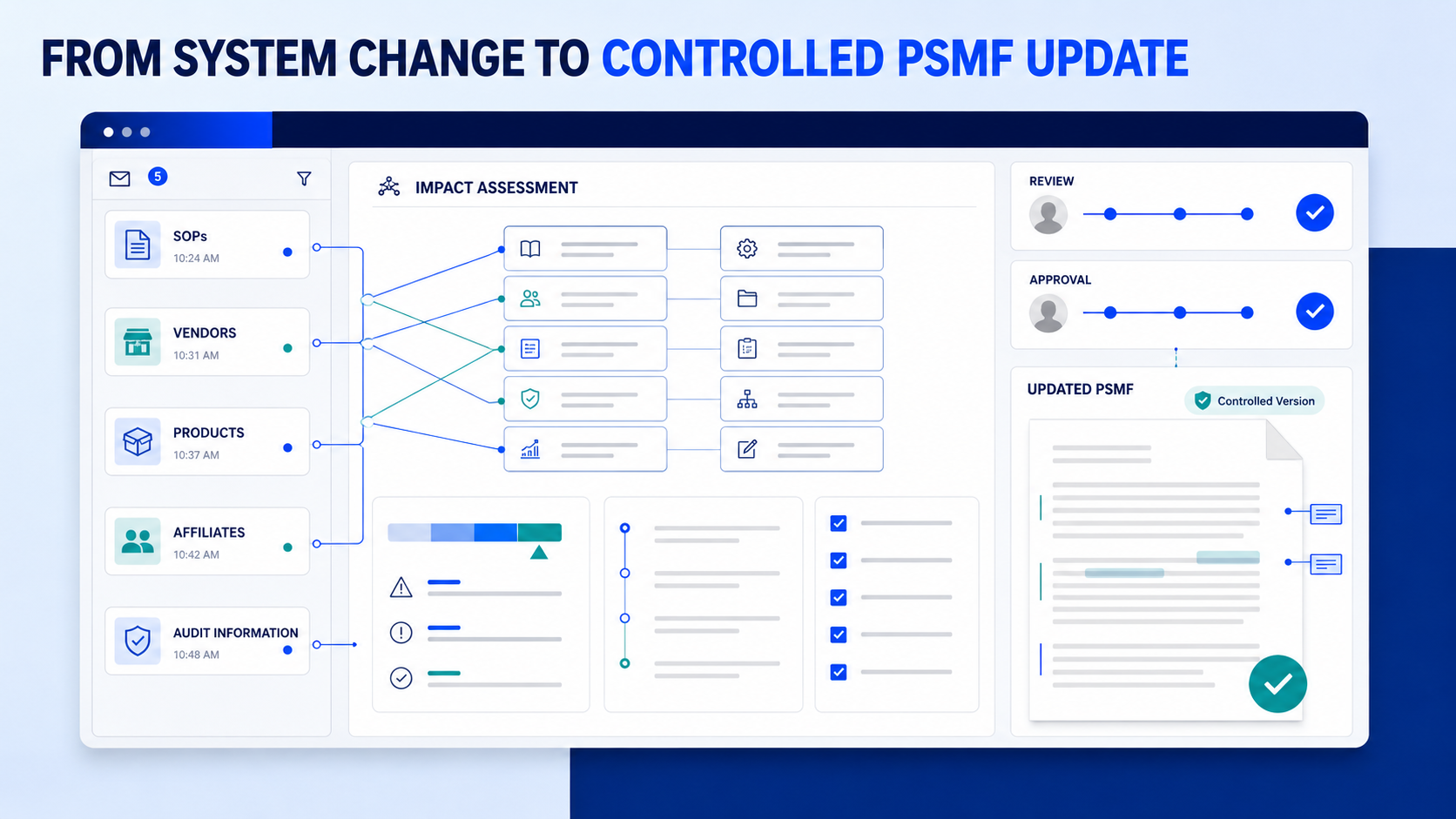
12 Capabilities That Show Whether PSMF Control Really Holds Up
| Sr. No. | Feature | What to Check |
|---|---|---|
| 1 | Regulatory-aligned structure | Can Sections, Annexes, and local requirements be managed within a controlled PSMF structure? |
| 2 | Global and local PSMFs | Can one global change be assessed across relevant country or affiliate PSMFs without unnecessary duplication? |
| 3 | GxP audit trail | Can the system show who performed an action, what happened, and when? |
| 4 | Version control and history | Can your team retrieve the approved PSMF that was active on a specific date? |
| 5 | Tracked changes | Can reviewers quickly see additions, deletions, and revisions without comparing files manually? |
| 6 | Role-based workflows | Are author, reviewer, approver, QPPV, affiliate, and external-user responsibilities clearly controlled? |
| 7 | Alerts and status visibility | Can the system flag pending reviews, overdue actions, and updates that still need assessment? |
| 8 | External data integration | Can relevant source changes enter a controlled review process instead of relying only on manual updates? |
| 9 | Controlled PSMF generation | Is the final PSMF created from approved Sections, Annexes, and Change Log information? |
| 10 | AI-assisted review | Does AI support review while keeping assessment and final decisions with human reviewers? |
| 11 | Centralized source information | Can shared information be controlled once instead of being repeated across different parts of the PSMF? |
| 12 | Controlled revision and retrieval | Are approved, under-revision, and historical versions clearly separated and protected from uncontrolled editing? |
For further reading, see Global vs Local PSMF Compliance, PSMF Version History vs Audit Trail, and AI and PSMF Oversight.
Two Foundations to Check Before Selecting a Platform
First, check validation and regulatory fit.
Do not assume every electronic PSMF system automatically falls under 21 CFR Part 11. FDA explains that Part 11 applies based on the electronic records, signatures, and underlying regulatory requirements involved.
Second, review security and business continuity. Look at access controls, authentication, backups, recovery, and system availability.
These are not extra features. They help determine whether the system is suitable for its intended use.
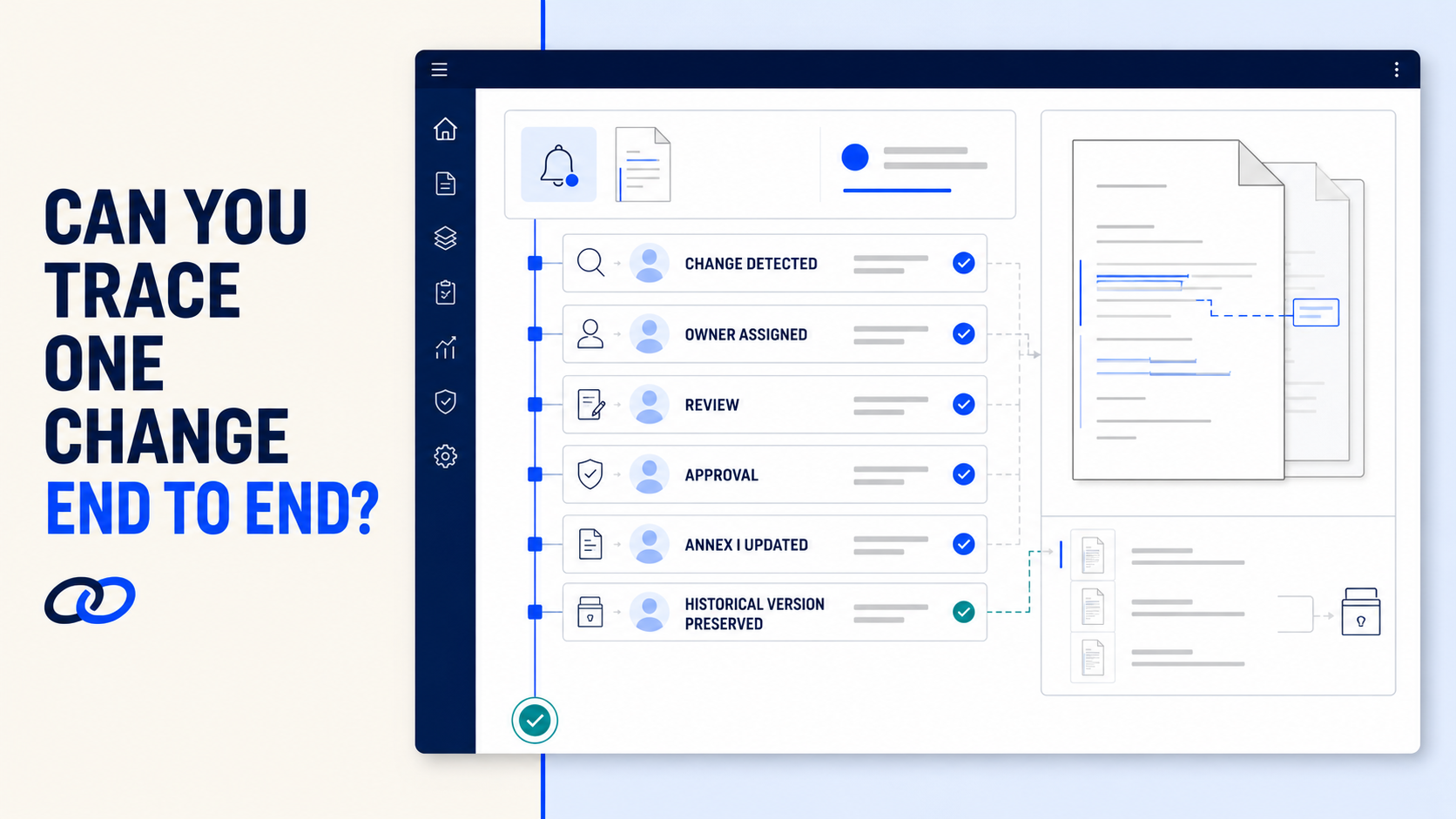
The Real Test Comes When You Trace One Change
A long feature list can look impressive. A real workflow tells you much more.
Ask the system provider to demonstrate one simple scenario:
A source changes. The PSMF impact is assessed. The update is reviewed and approved. Annex I is addressed. The audit trail is preserved. The previous approved version can still be retrieved.
If the full story is visible within the system, the platform is supporting controlled PSMF governance.
If the team still needs emails, spreadsheets, shared folders, and individual memory to explain what happened, the underlying control problem remains.
The objective is not simply faster PSMF generation. It is a PSMF that remains controlled, traceable, reviewable, and ready when the evidence is needed.
See the PSMF Workflow in Practice
PSMF Manager provides dedicated workflows for global and local PSMFs, version history, tracked changes, external data sources, PSMF generation, and AI-assisted review.
Request a Demo to see how the platform works with your PSMF process.